

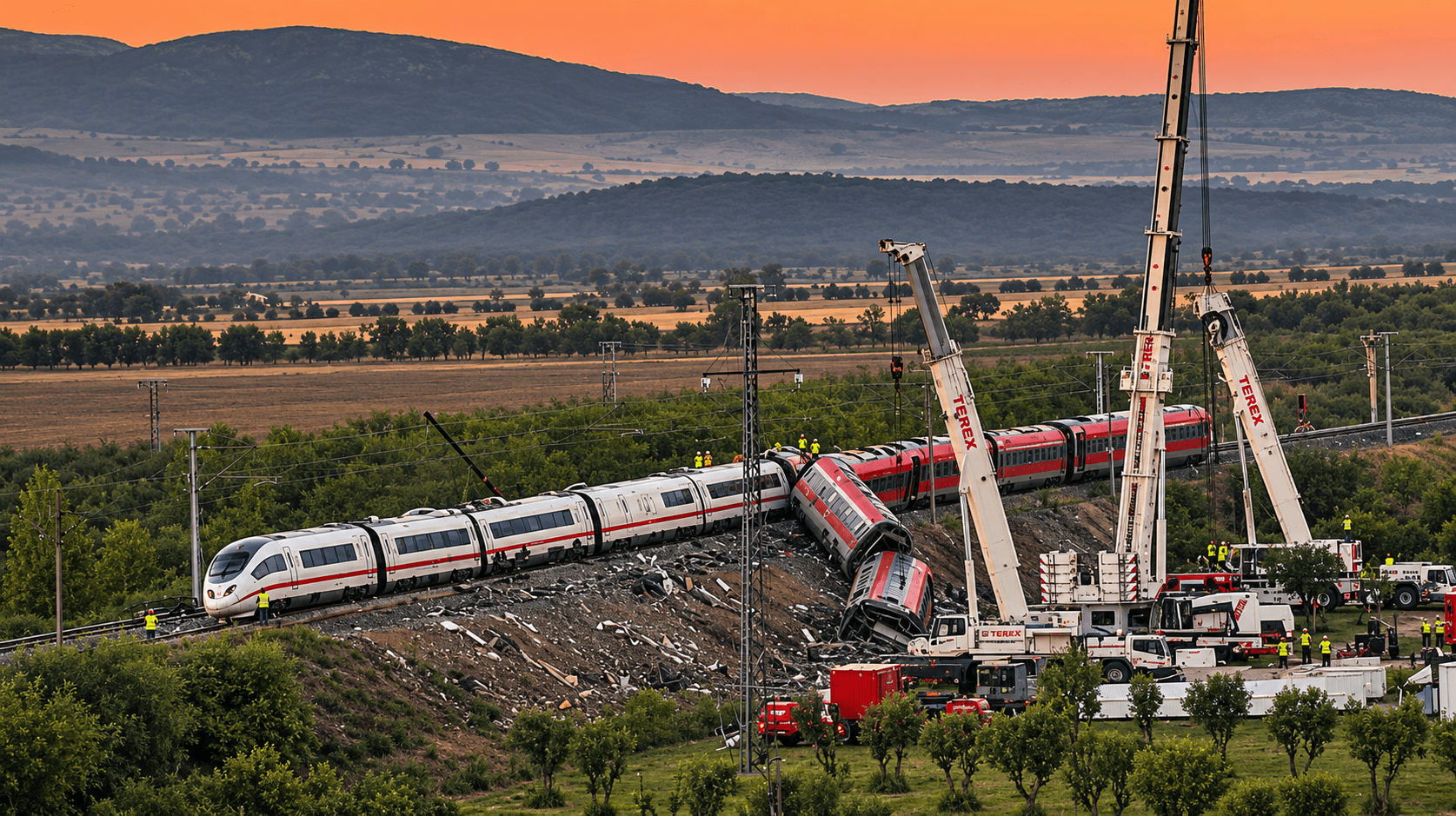
Spain is facing one of the darkest moments in its recent railway history after a collision between two high-speed trains in Toledo province killed at least 69 people and injured more than 200. The accident, which occurred near Urda on October 28, has triggered widespread concern about railway maintenance, signalling systems, staffing levels and the government's responsibility for passenger safety.
The collision involved a train operated by state-owned Renfe and another run by private operator Iryo on the Madrid–Seville high-speed line. Investigators are now trying to establish how one train was allowed to resume its journey while another remained stationary further along the same stretch of track.
Much of the early investigation has centred on the failure of the older LZB train-control system and the decisions made at the railway control centre after the malfunction. Transport Minister Óscar Puente is facing mounting calls to resign, while railway unions warn against placing all the blame on an individual controller. They argue that wider problems involving infrastructure, staffing and investment also deserve serious attention.
The tragedy has caused even greater concern because it follows another major railway accident earlier in January, which killed 46 people. With two deadly incidents occurring on the same high-speed corridor within a year, questions are being raised about whether Spain's railway infrastructure is keeping pace with growing passenger demand.
Prime Minister Pedro Sánchez has promised a thorough investigation, while King Felipe VI has called for steps to prevent another disaster. With Spain's November 29 election approaching, railway safety has also become a major political issue, putting government accountability and public infrastructure under intense scrutiny.
HOW THE DEADLY COLLISION UNFOLDED
According to the timeline presented by Transport Minister Óscar Puente and reported by the European news agency EFE, the events leading to the collision began at around 8:31 a.m. on October 28. A communication problem caused the LZB safety system to fail across a 63-kilometre section of the Madrid–Seville railway line.
The LZB system monitors train movements and can automatically activate braking when it detects a potential safety risk. Following the failure, trains operating along the affected section were stopped, leaving railway traffic controllers in Madrid responsible for managing movements manually.
Under emergency procedures, trains should not normally be allowed to enter an occupied section of track. Any permitted movement must follow strict restrictions, giving drivers enough time to stop if they encounter an obstruction.
However, at approximately 8:36 a.m., the control centre authorised a Renfe train to continue its journey at normal speed. An Iryo train further along the line remained stationary after failing to restart.
The Iryo service subsequently informed the control centre that it could not move. According to the minister's account, the message was received, but no effective intervention followed.
At around 8:53 a.m., the moving Renfe train collided with the stationary Iryo train.
Investigators are now examining recordings, communications and decisions made during the critical minutes before the crash. One of the biggest questions remains why the Renfe train was permitted to resume normal-speed operations while another train was still stopped on the same line.
LZB SAFETY SYSTEM FAILURE BECOMES A CENTRAL FOCUS
The failure of the LZB train-control system is one of the most important aspects of the ongoing investigation. The technology has been used on the Madrid–Seville high-speed route for decades and is designed to monitor train movements and help prevent dangerous situations.
Spain has been working towards introducing the European Rail Traffic Management System (ERTMS), a newer signalling and train-control standard intended to improve railway safety and interoperability across Europe.
However, the modernisation of the Madrid–Seville line has faced delays. A contract originally awarded in 2021 was subsequently transferred to another contractor. The upgraded system is now expected to become operational on the route in early 2027, around a year later than initially planned.
Transport Minister Puente has defended the existing LZB system, arguing that its failure rate has remained within historical and European averages. He has also suggested that an incorrect operational decision following the malfunction played a significant role in the accident.
Railway unions, however, believe the issue cannot be reduced to a single mistake. They say repeated technical problems have forced controllers and train drivers to work under difficult conditions, particularly when automated safety protections are unavailable.
The investigation will need to determine whether the equipment failure, delayed modernisation, emergency procedures or human decisions contributed to the collision. At this stage, the complete technical cause has not been established.
GOVERNMENT UNDER PRESSURE AS TRANSPORT MINISTER REFUSES TO RESIGN
What began as a devastating transport accident has quickly developed into a political challenge for Prime Minister Pedro Sánchez's government.
Transport Minister Óscar Puente has faced criticism from opposition politicians and railway workers over his handling of the incident and his public comments about the decisions made at the control centre.
Puente described the authorisation allowing the Renfe train to resume its journey as an error that was difficult to explain. Critics argue that concentrating on the controller's decision could divert attention from broader questions about railway infrastructure, maintenance and government oversight.
On October 30, the minister rejected calls for his resignation, defending his response to the crisis while maintaining that the investigation must establish exactly what happened.
Opposition lawmakers have demanded greater accountability, while criticism of the government's handling of railway safety has emerged from different political quarters.
Sánchez has acknowledged the seriousness of the disaster and promised a full examination of the circumstances. He has described two major railway accidents within a single year as unacceptable for a country known internationally for its high-speed rail network.
The government now faces a difficult balancing act: reassuring passengers that the railway system remains safe while allowing investigators to establish whether deeper institutional or technical failures contributed to the tragedy.
RAILWAY UNIONS RAISE CONCERNS OVER STAFFING AND WORKING CONDITIONS
Railway unions have strongly challenged the idea that the disaster can be explained primarily by an individual operational mistake. They argue that the working conditions of railway employees and the state of the infrastructure must also form part of the investigation.
Representatives of Spain's railway traffic controllers have highlighted concerns about staffing shortages, heavy workloads and recurring problems with safety equipment. According to union representatives, requests for additional personnel have been raised for years, while controllers continue to manage increasingly demanding railway operations.
The train drivers' union SEMAF has also questioned why the ageing LZB system remains in operation on such an important high-speed route when plans to replace it have been under way for years.
Union leaders argue that automated safety technology provides an essential layer of protection, particularly when railway workers are dealing with complicated or unexpected situations. When these systems fail, the responsibility placed on human operators increases considerably.
Railway workers also proceeded with a previously planned strike on October 29, calling on the government to honour its commitments to improve safety following the January accident.
The timing of the industrial action, just one day after the latest collision, has brought renewed attention to working conditions across Spain's railway network.
Unions are demanding a broader review of staffing, maintenance, training and infrastructure spending. They insist that the investigation should look beyond individual decisions and examine whether the railway system has the resources needed to operate safely.
SECOND MAJOR RAILWAY DISASTER IN A YEAR DEEPENS SAFETY CONCERNS
The October collision has brought back painful memories of the January 2026 accident near Adamuz in Córdoba, where 46 people died in another serious collision involving Renfe and Iryo services.
With both disasters occurring on the Madrid–Seville high-speed corridor, concerns about the condition of the route and the effectiveness of its safety arrangements have intensified.
The latest accident has also reopened the debate over the role of private operators in Spain's high-speed railway network. Competition was introduced in 2021, bringing more services and greater choice for passengers. However, unions argue that increased railway traffic must be supported by sufficient investment in maintenance, infrastructure and safety systems.
Railway representatives have pointed to the significant increase in passenger services on some major routes since the market opened to private operators. Their concern is that additional traffic could put pressure on signalling systems, maintenance schedules and operational staff if infrastructure capacity and safety resources do not grow at the same pace.
However, investigators have not established that railway liberalisation or private-sector participation caused either accident. These questions remain part of the wider discussion about network capacity, investment and management.
Spain's high-speed railway system has long been considered one of the country's major infrastructure achievements. The latest disaster has therefore raised difficult questions about whether the network is receiving the investment and attention needed to maintain passenger confidence.
NOVEMBER ELECTION CAMPAIGN TAKES A NEW TURN AFTER THE CRASH
The tragedy has significantly changed Spain's political conversation ahead of the November 29 election.
Before the accident, the campaign had largely focused on housing affordability, the cost of living and social policy. Railway safety, infrastructure management and government accountability have now moved to the forefront.
Conservative opposition leader Alberto Núñez Feijóo has called for accountability, while his Popular Party suspended campaign activities for two days following the disaster.
Vox leader Santiago Abascal has taken a more confrontational approach, criticising Sánchez's government and demanding political responsibility.
The accident has placed the prime minister's Socialist Party in a difficult position, with growing questions about public infrastructure and the government's response to repeated railway disasters.
Polling cited by Al Jazeera on October 30 showed the Popular Party ahead of the Socialists, with Vox in third place. Whether the railway tragedy will significantly influence voting intentions remains uncertain, but it is likely to remain a major campaign issue.
The government must now demonstrate that it is supporting victims and their families while providing clear and transparent answers. Opposition parties, meanwhile, are expected to keep pressure on the administration over railway safety and ministerial accountability.
INVESTIGATION, VICTIM IDENTIFICATION AND THE CHALLENGE OF RESTORING PUBLIC TRUST
Judicial authorities and a separate government commission are investigating the collision. Their work includes examining train data recorders, communications between drivers and controllers, signalling records and decisions made after the LZB system failed.
Identifying the victims has also been difficult because of the severity of the crash. In the days following the accident, authorities continued working to establish the identities of those killed and contact their families.
As of November 1, the reported death toll stood at at least 69, with more than 200 people injured.
King Felipe VI has visited injured passengers in hospital and called for a thorough investigation. His response reflects the wider public demand for answers and concrete measures to prevent another tragedy.
Investigators must establish whether the LZB malfunction resulted from a technical defect, a communication problem or another underlying issue. They will also need to determine whether emergency procedures were properly followed and why the Renfe train was authorised to continue while the Iryo service remained stationary.
Rebuilding public confidence will take more than official assurances. Passengers will want to see clear investigation findings, practical improvements to railway safety and accountability wherever failures are established.
RISKS AND KEY ISSUES TO WATCH
Signalling-system failures: Investigators may uncover whether recurring LZB malfunctions created wider vulnerabilities across the railway network.
Staffing and operational pressure: Concerns about controller shortages and heavy workloads could lead to a closer review of emergency procedures.
Delayed infrastructure upgrades: The postponed ERTMS rollout raises questions about modernisation plans and investment priorities.
Political accountability: Continued pressure on Transport Minister Óscar Puente could create further difficulties for Sánchez's government.
Railway worker unrest: Additional strikes could disrupt services and increase pressure on authorities to improve working conditions.
Public confidence: Repeated accidents may affect passenger trust in Spain's high-speed railway services.
Victim identification and compensation: Families will need accurate information, appropriate support and transparent compensation processes as investigations continue.
WHAT TO WATCH NEXT
Judicial investigation: Whether investigators identify specific technical or operational failures that contributed to the collision.
Black-box analysis: Data from train recorders and communication logs could help reconstruct the final moments before impact.
Government safety review: Whether authorities announce additional inspections, emergency measures or operating restrictions on other routes.
ERTMS modernisation: Whether the Madrid–Seville line meets its revised early-2027 upgrade deadline.
Ministerial accountability: Whether opposition pressure leads to further political consequences for Puente or the wider government.
Railway union action: Whether unions announce further strikes or reach an agreement with the government on safety improvements.
November 29 election: Whether railway safety becomes a defining issue in Spain's upcoming election.
FACT CHECK METER
EDITORIAL CONFIDENCE: 97%
Status: Strongly supported — investigation ongoing
Confirmed details
The collision occurred on October 28, 2026, near Urda in Toledo province.
At least 69 people were reported dead, with more than 200 injured.
The trains involved were operated by Renfe and Iryo.
The LZB safety system failed before the collision.
The control centre authorised a Renfe train to resume its journey while an Iryo train remained stationary.
Judicial and government investigations are examining the circumstances surrounding the disaster.
Transport Minister Óscar Puente has rejected calls for his resignation.
Important distinctions
The LZB failure is a major focus of the investigation, but the complete technical cause has not yet been established.
The control centre's decisions are under scrutiny, but individual criminal responsibility has not been determined.
Union concerns about staffing and maintenance require independent examination.
The role of railway liberalisation and private operators has not been established as a cause of the collision.
The final death toll and victim identification figures may change as authorities complete their work.
AWX VERDICT
Spain's railway disaster has exposed serious questions about infrastructure safety, emergency procedures and the pace of modernisation. The signalling failure and decisions made at the control centre are central to the investigation, while railway unions are calling for wider concerns about staffing, maintenance and investment to receive equal attention.
The final findings will be essential in determining where responsibility lies and what changes are needed to prevent another tragedy.
The percentage represents AWX's editorial confidence in the factual reporting, not a statistical probability or an official investigation rating.
THE AWX BOTTOM LINE
Spain's deadly train collision has become far more than a transport disaster. It has raised fundamental questions about the reliability of railway infrastructure, the effectiveness of safety systems and the government's responsibility to protect passengers.
The failure of the LZB system, the decision to allow one train to resume its journey and the concerns raised by railway unions point to a complicated chain of events that requires careful investigation.
Drawing conclusions before all the evidence is available could mean overlooking the wider technical and institutional issues that may have contributed to the tragedy.
With at least 69 lives lost and hundreds more affected, the consequences will extend well beyond the immediate emergency. The government faces growing pressure to provide answers, strengthen railway safety and restore public confidence ahead of the November 29 election.
Ultimately, Spain's response will be judged not only by the findings of the investigation but also by the reforms that follow. Better maintenance, modern signalling systems, adequate staffing and stronger safety procedures will be essential to ensuring that such a disaster does not happen again.
ATTLAS NEWS | AWX WORLD NEWS
Real Stories. Lasting Impact.
Comments
No comments yet.