

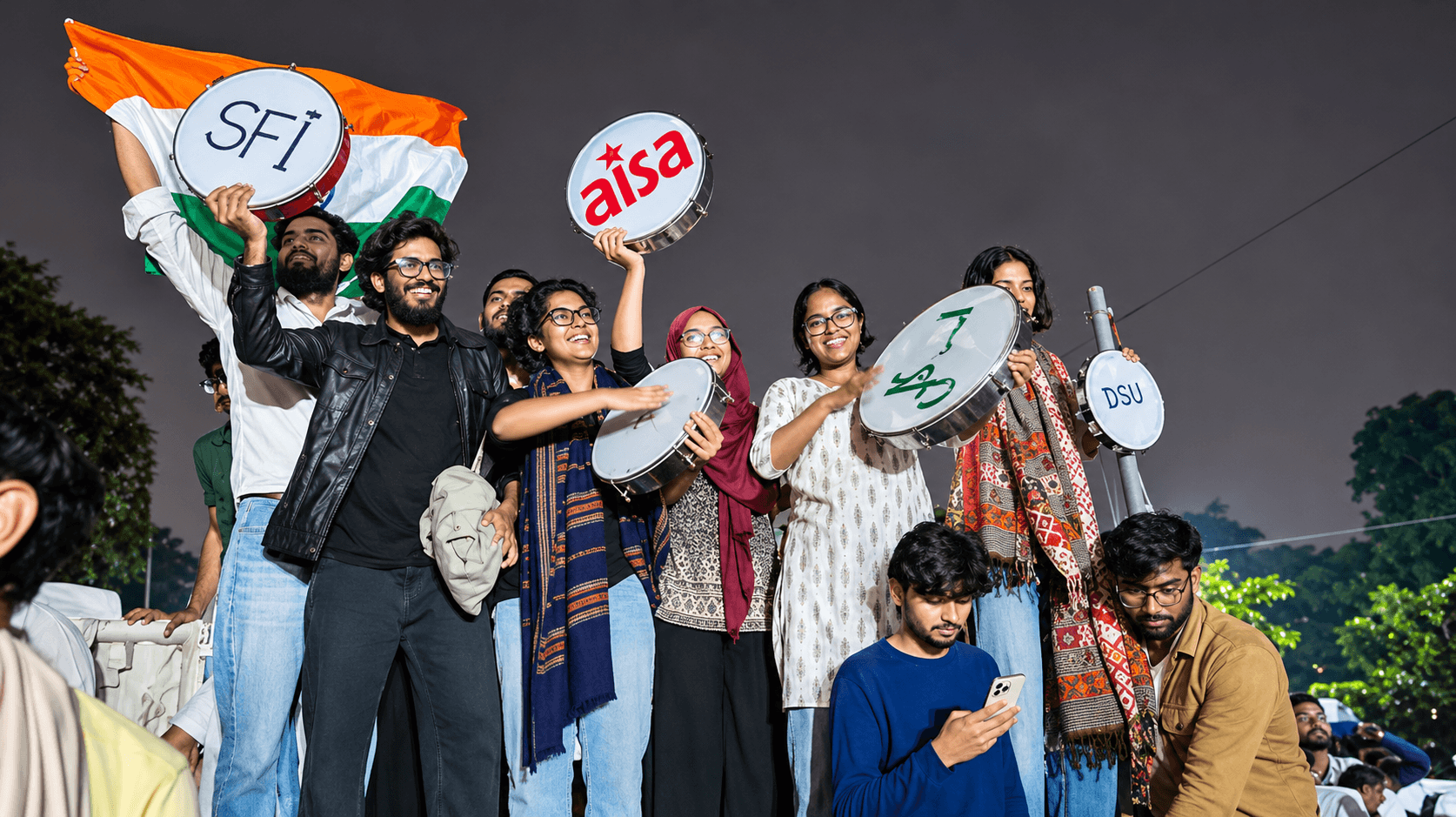
Jamia Millia Islamia (JMI) is moving towards restoring its elected students’ union after nearly 20 years, following an agreement between the university administration and protesting students. The breakthrough came after weeks of demonstrations, an 18-day hunger strike and prolonged negotiations over the revival of the Jamia Millia Islamia Students’ Union (JMISU).
On October 29, the university issued an official order setting a deadline of May 15, 2027, for approving and implementing the students’ union constitution. Elections are expected to take place within six weeks of the start of the next academic session, which is anticipated around July 16, 2027. The process will follow the recommendations of the Lyngdoh Committee.
The announcement brought an end to an 18-day protest that had disrupted normal academic activities and attracted attention from students, alumni and civil society groups. Several students had gone on an indefinite hunger strike, demanding a clear commitment from the administration rather than another general assurance about restoring elections.
The university has also agreed to withdraw disciplinary proceedings linked to the protests. These include show-cause notices, suspensions, rustication orders and restrictions on campus entry.
Students welcomed the decision, describing it as an important victory for campus democracy and collective action.
The development is particularly significant because Jamia has not had a university-wide elected students’ union since 2006. Its restoration could give students a stronger platform to raise concerns about academic policies, fees, campus facilities and student welfare.
AFTER NEARLY 20 YEARS, JAMIA SETS A CLEAR ELECTION TIMELINE
The latest decision addresses the main demand behind the protests: a definite timetable for bringing back the elected students’ union.
According to the Registrar’s October 29 order, the JMISU constitution must be approved and implemented by May 15, 2027. Elections will then be held within six weeks of the beginning of the next academic session, which is expected to start around July 16, 2027.
This places the likely election period around August 2027, although the final date will depend on the academic calendar and completion of the constitutional process.
The elections will follow the Lyngdoh Committee guidelines, which provide recommendations for conducting student-union elections at Indian universities. These cover areas such as candidate eligibility, campaign practices and electoral procedures.
For students who have spent years without a university-wide elected representative body, the announcement represents a major change. During this period, departmental subject associations have provided some representation, but they have not offered the same institution-wide platform as an elected union.
The next step will be for the university to finalise the constitution, establish the union's structure and put a transparent election process in place.
18 DAYS OF PROTEST AND HUNGER STRIKE LEAD TO BREAKTHROUGH
The agreement followed a sustained protest movement that began on October 12, 2026. Five students took part in the hunger strike, pressing the administration to restore the students’ union and announce a firm election schedule.
Among the prominent protesters was law student Ebin Basil, who completed 18 days on hunger strike. Another student, Rehan Mewati, also participated in the prolonged fast.
The protesters argued that the absence of an elected university-wide body had left students without a common platform to raise collective concerns or hold the administration accountable. They wanted an independent organisation capable of representing students across different faculties and departments.
Tensions increased after disciplinary action was taken against some participants. Students raised objections to suspensions, rustication orders and restrictions on campus access, making the withdrawal of these measures an important part of the negotiations.
Following the revised university order, the hunger strike was called off. Students also organised a victory march on campus to celebrate the announcement. Reports indicated that more than 1,000 students joined the celebrations, bringing an end to a protest that had become a major issue in Jamia's campus life.
Ebin Basil described the outcome as a victory for student democracy, while other organisers credited collective participation and sustained pressure for securing the administration's commitment.
WHY JAMIA'S STUDENTS' UNION WAS DISSOLVED IN 2006
The history of student representation at Jamia has been marked by disagreements over campus discipline, university administration and the role of elected student bodies.
The university last held students’ union elections in 2005. On March 31, 2006, the administration dissolved the elected body, citing incidents of campus violence and disruptions to academic activities. The university also referred to an attack on the then Vice-Chancellor as part of its justification.
The union remained inactive in the years that followed, with successive administrations choosing not to restore a university-wide elected body. Students instead relied largely on departmental subject associations, which provided representation within individual academic departments.
The issue resurfaced several times. In 2017, the university proposed a student council system under which class representatives would elect office-bearers. However, students opposed the proposal, arguing that it would not provide the independence and representative authority of a directly elected union.
The matter also reached the Delhi High Court through a legal challenge filed in 2012. The petition was disposed of in December 2022 after the university informed the court that the union had been dissolved. The court neither directed the university to conduct elections nor prevented it from restoring the union.
For many students, the absence of a central elected body meant there was no single university-wide platform to address issues involving hostel facilities, fees, campus security, academic policies and student welfare.
EARLIER AGREEMENT FAILED TO SATISFY STUDENTS
The October 29 breakthrough came after an earlier attempt by the university to resolve the dispute failed to convince the protesters.
On October 26, the Registrar's Office had indicated that elections would be held within 15 days of approval of the students' union constitution. However, the announcement did not specify when the constitution itself would be completed.
Students were concerned that without a firm deadline for approving the constitution, the election commitment could be delayed indefinitely.
They had demanded that the constitution be completed by December 20, followed by elections within 15 days. The administration's revised order instead fixed May 15, 2027, as the deadline for approving and implementing the constitution, with elections to follow within six weeks of the next academic session.
The difference was central to the negotiations. Students wanted a commitment that could be measured against a specific timetable, rather than another open-ended promise.
The revised order also addressed another major concern: disciplinary action against those who had participated in the agitation.
DISCIPLINARY ACTION TO BE WITHDRAWN AS CAMPUS RETURNS TO NORMAL
The withdrawal of disciplinary proceedings was another important outcome of the agreement.
The university has agreed to revoke protest-related show-cause notices, suspensions, rustication orders and restrictions on campus entry. Students had argued that disciplinary measures should not continue against those involved in the demonstrations.
The earlier October 26 arrangement had not fully resolved the status of students who had been rusticated or barred from entering the campus. The revised order expanded the administration's commitment to cover these actions as well.
The university also announced plans to resume offline classes and examinations in November after academic activities had shifted online during the agitation. The move is intended to help students and staff return to their regular schedules.
Although the end of the protest has eased immediate tensions, the implementation of the agreement will remain under scrutiny. Students will be looking for confirmation that disciplinary proceedings are formally withdrawn and that the constitutional process moves forward within the announced deadline.
JAMIA'S DECISION ADDS MOMENTUM TO STUDENT POLITICS ACROSS UNIVERSITIES
The development has attracted attention beyond New Delhi, particularly because of a similar movement at Aligarh Muslim University (AMU).
Students at AMU had also been demanding the restoration of their students’ union elections after a prolonged period without polling. Following a 19-day hunger strike, the university administration agreed to hold elections on November 5, 2026.
The developments at AMU helped bring fresh attention to the campaign for student representation at Jamia.
Together, the two movements have renewed discussion about the importance of elected student unions in Indian universities.
Supporters argue that student unions give young people an opportunity to participate in democratic processes, develop leadership skills and raise concerns directly with university authorities. They can also provide an organised channel for addressing issues related to education, accommodation, fees and student welfare.
At the same time, universities have raised concerns about political interference, campus disruptions and violence during student elections. The Lyngdoh Committee guidelines were introduced to encourage more transparent and disciplined election processes.
Jamia will now face the challenge of bringing back elected student representation while ensuring that the new system operates within university rules and established election guidelines.
RISKS AND KEY ISSUES TO WATCH
Implementation delays: The university must approve and implement the students’ union constitution by May 15, 2027, to avoid further dissatisfaction.
Election transparency: The process must follow Lyngdoh Committee guidelines and ensure fair opportunities for eligible candidates.
Student representation: The final constitution will determine the union's structure, responsibilities and authority.
Withdrawal of disciplinary action: Students will expect all protest-related suspensions, rustications and campus restrictions to be formally revoked.
Campus politics: The return of elections could bring increased political activity and competition between student groups.
Academic normalcy: The university will need to maintain regular classes and examinations while addressing future student concerns.
Administrative accountability: Students may expect greater transparency and consultation on decisions affecting campus life.
WHAT TO WATCH NEXT
May 15, 2027 deadline: Whether Jamia completes the approval and implementation of the JMISU constitution on schedule.
Election notification: The university's formal announcement of the election programme and candidate eligibility rules.
August 2027 polling window: Whether elections take place within six weeks of the next academic session.
Constitutional framework: Details of the union's structure, office-bearers, voting procedures and representation.
Disciplinary withdrawals: Confirmation that all protest-related proceedings and restrictions have been revoked.
Student participation: Whether the restored union attracts broad participation across faculties and departments.
AMU election developments: The November 5 election at Aligarh Muslim University could offer another important example of student-union restoration.
FACT CHECK METER
Editorial confidence: 99%
Status: Confirmed — based on reported official university orders
Confirmed details
Jamia's last students' union elections were held in 2005.
The elected union was dissolved in March 2006.
The administration issued a revised order on October 29, 2026.
The JMISU constitution must be approved and implemented by May 15, 2027.
Elections are to be held within six weeks of the next academic session.
The university agreed to withdraw disciplinary proceedings connected with the protests.
Students ended their 18-day agitation following the announcement.
Important distinctions
The university has committed to a time-bound restoration process; elections have not yet taken place.
May 15, 2027, is the deadline for the union constitution, not the polling date.
Elections are expected around August 2027, subject to the academic calendar.
The union's final structure and responsibilities will depend on the approved constitution.
AWX VERDICT
Jamia's decision marks an important step towards restoring student democracy after nearly two decades without a university-wide elected union. Sustained protests and hunger strikes pushed the administration to announce a clear constitutional deadline, an election timeline and the withdrawal of disciplinary action. The real test now lies in turning these commitments into action.
The percentage represents AWX editorial confidence in the factual reporting, not a statistical probability or an official university rating.
THE AWX BOTTOM LINE
Jamia Millia Islamia's decision to restore its students' union marks a significant moment in the university's history. After almost 20 years without a university-wide elected representative body, students have secured a formal commitment to bring campus elections back.
The 18-day hunger strike and weeks of demonstrations highlighted how strongly students feel about having an elected platform to represent their interests. The administration's decision to set a deadline and withdraw protest-related disciplinary action has helped bring the immediate confrontation to an end.
But the announcement is only the beginning. Jamia must now complete the union constitution by May 15, 2027, and organise elections within the promised timeframe.
If the agreement is implemented successfully, it could reshape campus politics, encourage greater student participation and restore an important democratic institution at one of India's prominent universities.
ATTLAS NEWS | AWX WORLD NEWS
Real Stories. Lasting Impact.


Comments
No comments yet.