

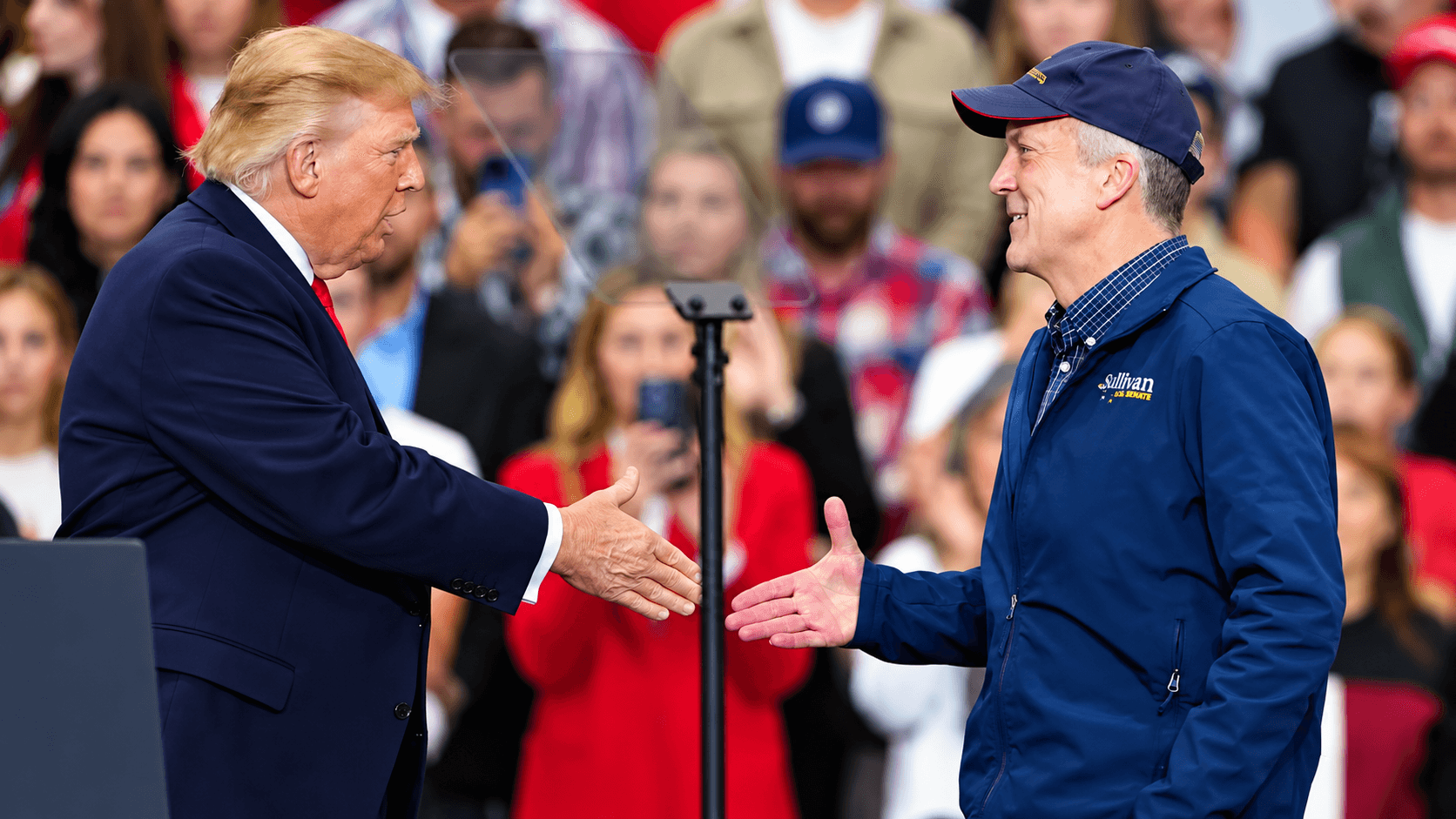
The United States is facing another major election-related legal dispute just days before the November 3 midterm elections. The Trump administration has intensified its investigation into allegations of a coordinated effort to influence Alaska's closely watched Senate race, while the Justice Department is pursuing legal action that could affect how the state counts and certifies votes.
The controversy centres on two candidates with similar names appearing on Alaska's Senate ballot: Republican incumbent Senator Dan S. Sullivan and Daniel J. Sullivan Jr. The Justice Department claims that the second candidate's presence could confuse voters and draw support away from the incumbent, potentially influencing a race that could play an important role in determining control of the US Senate.
The issue gained further attention after President Donald Trump acknowledged that he had personally directed the Justice Department to pursue the lawsuit. Federal authorities have also expanded their criminal investigation, assigning additional resources to examine allegations that individuals linked to Democratic political circles encouraged the second Sullivan to enter the race as a so-called spoiler candidate.
However, the accusations remain disputed. Democratic candidate Mary Peltola has denied any involvement in the alleged effort, while Daniel J. Sullivan Jr. has rejected suggestions that he entered the race to mislead voters. Alaska officials have also challenged the federal government's attempt to intervene in the state's election procedures.
With voting already underway, the case has developed into a much broader debate over the limits of federal authority, the independence of state election systems and the protection of voters' rights.
ALASKA SENATE RACE BECOMES THE FOCUS OF A NATIONAL LEGAL BATTLE
Alaska's Senate contest has attracted national attention because its outcome could influence the balance of power in Washington. Republican Senator Dan S. Sullivan is seeking another term, with former congresswoman Mary Peltola challenging him as the Democratic candidate.
The ballot also features Daniel J. Sullivan Jr., a retired teacher whose name closely resembles that of the incumbent senator. The Justice Department argues that the similarity could lead some voters to select the wrong candidate, potentially affecting the final outcome.
Alaska election officials had previously attempted to prevent Sullivan Jr. from appearing on the ballot, citing concerns about his candidacy. However, a state court overturned that decision in June, allowing him to remain in the race. The ballot identifies the two candidates separately through their respective descriptions and party affiliations.
The Justice Department filed its lawsuit on October 22, asking a federal court to prevent Alaska from certifying an election result that might have been affected by voter confusion. The department subsequently amended its complaint and sought additional measures as its investigation progressed.
The timing of the lawsuit is particularly significant. Rather than challenging an election result after the votes have been counted, the federal government is attempting to intervene before the outcome is known. This has raised questions about the legal grounds for federal involvement in an election administered by state authorities.
JUSTICE DEPARTMENT STEPS UP INVESTIGATION INTO ALLEGED SPOILER CANDIDACY
The controversy intensified on October 30 when Alaska's top federal prosecutor, US Attorney Michael Heyman, confirmed that a criminal investigation was underway.
Heyman said investigators were examining credible information about an alleged attempt to deceive voters and that the inquiry was moving forward quickly.
The investigation follows media reports suggesting that individuals associated with Peltola's campaign may have helped recruit Daniel J. Sullivan Jr. to enter the Senate race. Federal investigators are examining whether the candidacy was part of a coordinated effort to confuse voters and influence the election.
Peltola has firmly rejected the allegations, stating that she had no knowledge of any attempt to recruit the second Sullivan. At this stage, the accusations have not been established in court. The existence of a criminal investigation alone does not prove that any candidate or campaign committed a crime.
The Justice Department has also asked to preserve and separate ballots on which voters ranked Daniel J. Sullivan Jr., arguing that this would help investigators determine whether voters mistakenly selected him.
Alaska election officials have pushed back against the request. They maintain that the ballot already contains information distinguishing the two candidates and that the state's ranked-choice voting system offers additional protection against the potential impact of voter confusion.
COURT BATTLE RAISES QUESTIONS ABOUT FEDERAL ELECTION AUTHORITY
At the centre of the legal dispute is a fundamental question: how far can the federal government go in intervening in a state-administered election before the results are known?
The Justice Department has relied on provisions of the National Voter Registration Act, arguing that federal election-integrity requirements provide a legal basis for its intervention.
Critics, however, question whether the legislation gives the federal government such broad powers. They argue that the law primarily deals with voter registration and does not automatically allow federal authorities to control ballot design, determine candidate eligibility or dictate how a state certifies its election results.
Alaska's Republican-led government has challenged the lawsuit, arguing that the Justice Department does not have the authority to dictate how the state manages its election certification process.
The state's opposition is particularly notable because the dispute is not simply a disagreement between the Trump administration and Democratic officials. Republican leaders in Alaska have also raised concerns about the federal government's approach.
Republican Senator Lisa Murkowski has criticised the Justice Department's decision to file the lawsuit, while legal experts have questioned whether the department's interpretation of federal election law can support the measures it is seeking.
Another important development came on October 31, when the Associated Press reported that a federal judge had blocked the administration from attempting to separate the disputed ballots or threatening election officials over the matter.
The ruling represents a setback for the administration's legal strategy and places further limits on its immediate actions. However, it does not bring the wider investigation or the underlying legal dispute to an end.
RANKED-CHOICE VOTING ADDS ANOTHER LAYER TO THE CONTROVERSY
Alaska uses ranked-choice voting in its general elections, allowing voters to rank candidates according to their preferences rather than choosing only one person.
If no candidate receives the required majority of first-choice votes, the candidate with the fewest votes is eliminated. Their ballots are then transferred to the next available preference marked by each voter. This process continues until a candidate reaches the required threshold.
The system is relevant to the current controversy because a voter who mistakenly ranks Daniel J. Sullivan Jr. first could still have their vote transferred to Senator Dan S. Sullivan if they have listed the incumbent as their next preference.
Election specialists cited by FactCheck.org have suggested that ranked-choice voting could reduce the impact of a spoiler candidacy compared with a traditional winner-takes-all election.
However, the extent of that protection depends on how voters complete their ballots. If a voter does not rank the incumbent as another preference, the vote may not ultimately transfer to him.
The Justice Department maintains that the similar names could still mislead voters. State officials, meanwhile, argue that the ballot descriptions and ranked-choice process provide safeguards against such confusion.
NATIONAL ELECTION DISPUTES ADD TO MIDTERM PRESSURE
The Alaska case is unfolding alongside other election-related legal disputes involving the Trump administration.
In California, the Justice Department has challenged aspects of the state's voter registration procedures and its handling of allegations involving noncitizen voting. Federal authorities have sought restrictions affecting certain ballots while investigating individuals they believe may not be eligible to vote.
California officials have opposed the administration's approach, arguing that aggressive federal intervention could affect eligible voters and disrupt established election procedures.
On October 30, a federal appeals court rejected the administration's request to temporarily prevent California from counting mail ballots associated with more than 20,000 registered voters identified as potentially noncitizens.
A separate ruling reported by the Associated Press on October 31 also paused certain federal investigations in nine states until after Election Day. The decision reflected concerns that such investigations could discourage eligible citizens from participating in election-related activities.
These developments have intensified the national debate over the balance between election security and voting rights.
The Trump administration maintains that its actions are necessary to prevent election manipulation and protect the integrity of the voting process. Critics argue that extensive federal involvement during an active election could create uncertainty, place pressure on election officials and undermine public confidence in the results.
As a result, the controversy has moved beyond Alaska. It has become part of a wider national discussion about federal authority, state election independence and the protections needed to ensure that eligible voters can participate without interference.
RISKS AND KEY ISSUES TO WATCH
Election certification uncertainty: Further legal proceedings could complicate or delay the formal certification of Alaska's Senate results.
Voter confusion allegations: The presence of two similarly named candidates has raised concerns about whether some voters could mistakenly select the wrong person.
Federal-state power struggle: The case could establish important legal boundaries for federal intervention in state-administered elections.
Pressure on election officials: Public accusations, investigations and legal threats could affect the independence of officials responsible for conducting the vote.
Protection of voting rights: Attempts to isolate or scrutinise certain ballots raise questions about whether every eligible voter's choice will be treated fairly.
Control of the US Senate: Alaska's election could have wider political consequences, particularly if the result influences the balance of power in Congress.
WHAT TO WATCH NEXT
Further court proceedings: Whether judges impose additional restrictions on the Justice Department's efforts to intervene in Alaska's election.
November 3 election results: How the Senate race unfolds, including the distribution of first-choice votes and subsequent preference transfers.
Criminal investigation: Whether federal prosecutors uncover evidence of unlawful coordination, financial support or deliberate attempts to mislead voters.
Responses from Peltola and Sullivan Jr.: Whether either candidate provides further statements or evidence addressing the allegations.
Alaska's certification process: Whether state election officials can complete the vote count and certification without further legal obstacles.
National election implications: Whether the case influences similar legal challenges or election-administration decisions in other states.
FACT CHECK METER
EDITORIAL CONFIDENCE: 95%
Status: Strongly supported — legal proceedings ongoing
Confirmed details
The Justice Department filed a lawsuit concerning Alaska's Senate election certification on October 22.
President Trump publicly acknowledged directing the department to pursue the lawsuit.
Two candidates with similar names appear on Alaska's Senate ballot.
Alaska's top federal prosecutor confirmed that a criminal investigation was underway.
Mary Peltola denied knowledge of the alleged recruitment effort.
The Associated Press reported that a federal judge restricted the administration's attempt to separate disputed ballots and threaten election officials.
Important distinctions
Allegations of a coordinated spoiler-candidate scheme have not been established as criminal wrongdoing.
The ongoing investigation does not establish that Peltola or anyone associated with her campaign committed an offence.
The lawsuit concerns possible future election certification, not an already established fraudulent election result.
Ranked-choice voting could reduce the effect of a mistaken first-choice vote, depending on voters' subsequent preferences.
Court restrictions on specific federal actions do not automatically bring the wider investigation to an end.
AWX VERDICT
The Alaska dispute represents a significant legal confrontation involving election administration, federal authority and voting rights. While the Trump administration argues that its intervention is necessary to investigate possible election manipulation, its allegations remain unproven. Alaska officials and federal court rulings have also challenged important aspects of the government's approach.
The eventual outcome will depend on the continuing court proceedings, the criminal investigation and the results of the November 3 election.
The percentage represents AWX editorial confidence in the factual reporting, not a statistical probability or an official judicial assessment.
THE AWX BOTTOM LINE
The dispute surrounding Alaska's Senate election has become one of the most closely watched legal battles ahead of the 2026 US midterm elections.
What initially appeared to be a controversy over two similarly named candidates has developed into a wider confrontation over presidential authority, state control of elections and the protection of voting rights.
The Trump administration insists that its intervention is necessary to investigate possible attempts to manipulate the election. However, the allegations have yet to be proven, while opposition from Alaska officials and recent court rulings have placed important limits on the government's actions.
The immediate focus now shifts to the November 3 vote and the counting and certification process that follows. The outcome could have consequences not only for Alaska's Senate race but also for how future disputes over state elections are handled across the country.
Ultimately, maintaining public confidence will require transparent investigations, independent judicial oversight and a fair process that ensures every eligible vote is counted accurately.
ATTLAS NEWS | AWX WORLD NEWS
Real Stories. Lasting Impact.



Comments
No comments yet.