

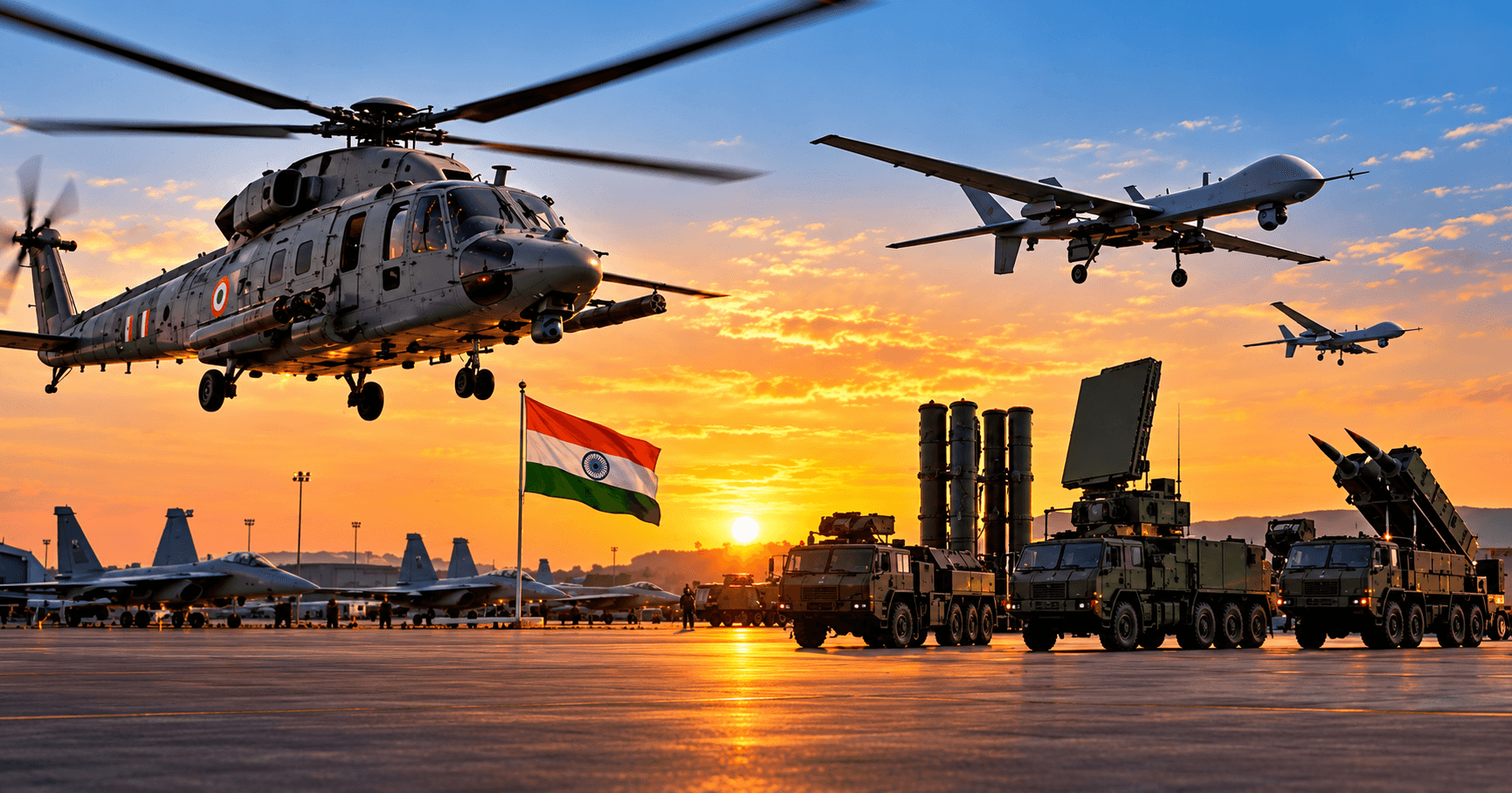
India has taken a major step towards modernising its armed forces, with the Defence Acquisition Council (DAC) approving defence procurement proposals worth approximately ₹2.12 lakh crore. Announced on October 26, the proposals cover equipment for the Army, Navy and Air Force, including artillery systems, helicopters, air-defence technology, surveillance drones and naval protection systems.
The meeting was chaired by Defence Minister Rajnath Singh. According to the Ministry of Defence, around 82% of the proposed procurement is expected to come from Indian industry. The move supports the government's broader push to strengthen domestic defence manufacturing and reduce dependence on foreign suppliers.
The proposed acquisitions aim to improve operational readiness, strengthen surveillance capabilities and help the armed forces respond to changing security threats. The inclusion of counter-drone systems and long-range unmanned platforms also reflects the growing role of drone technology in modern warfare.
However, the approval does not mean that all the equipment has been purchased. The DAC has granted Acceptance of Necessity (AoN), an initial clearance that allows the proposals to move to the next stages of the acquisition process. Final contracts, supplier selection and delivery schedules will be determined later.
The scale of the proposals highlights India's continuing efforts to upgrade its military capabilities while giving domestic manufacturers a greater role in supplying equipment to the armed forces.
INDIAN ARMY SET FOR A WIDE-RANGING MODERNISATION PUSH
The Indian Army accounts for a significant part of the latest proposals, which cover artillery, mobility, air defence, surveillance and unmanned systems.
The proposed acquisitions include High Mobility Vehicles (HMVs), a Self-Propelled Tracked Gun System, Gun Shot Response Systems, Light Multi Role Helicopters (LMRH), Very Short-Range Air Defence Systems (VSHORADS) and platform-based counter-unmanned aerial systems.
The list also includes long-range unmanned aerial systems, surveillance UAVs, an Integrated Surveillance and Strike System and a Long Range Kamikaze Drone System.
These systems are intended to address a range of operational needs. High Mobility Vehicles can improve troop movement and logistics in difficult terrain, while tracked artillery systems are designed to give mechanised units greater mobility and firepower. Gunshot detection technology can help troops identify the source of incoming fire more quickly.
Air-defence systems will play an important role in countering aerial threats, including small and low-flying targets. Counter-drone technology is also becoming increasingly important as unmanned aircraft are used for reconnaissance, surveillance and attacks.
The proposed long-range drones and integrated surveillance systems point to a growing emphasis on connecting battlefield intelligence with operational decisions. Better coordination between surveillance platforms and strike capabilities could help commanders assess threats and respond more quickly.
The final cost of each system and the timelines for individual contracts will become clearer as the procurement process moves forward.
NAVY LOOKS TO STRENGTHEN MARITIME DEFENCES
The Indian Navy is also expected to benefit from the latest round of approvals, with proposals covering an Active Offboard Decoy System (AODS) and other naval capabilities, including a next-generation destroyer.
The decoy system is designed to help protect warships against incoming anti-ship missiles. By drawing missiles away from their intended targets, such technology can provide an additional layer of defence in increasingly complex maritime environments.
Published reports indicate that the proposed next-generation destroyer is expected to be designed and built in India, with modern combat capabilities and a displacement of more than 10,000 tonnes.
These plans come as India continues to strengthen its maritime presence and protect its interests across the Indian Ocean region. The Navy must monitor busy shipping lanes, respond to emerging security threats and maintain readiness across a vast area of water.
Modern warships and improved defensive systems could support these objectives. Their actual impact, however, will depend on the final specifications, procurement arrangements and delivery schedules.
The focus on domestic shipbuilding could also create opportunities for Indian shipyards and defence suppliers to develop their engineering expertise and manufacturing capabilities.
AIR FORCE TO BENEFIT FROM HELICOPTERS, RADARS AND AIR-DEFENCE SYSTEMS
The Indian Air Force is another key beneficiary of the proposals, which cover helicopters, weapons, air-defence equipment and a Mobile X-Band Doppler Weather Radar System.
Special Utility Helicopters are intended to meet operational transport requirements, while Light Multi Role Helicopters are expected to support both the Army and the Air Force. Their potential roles include reconnaissance, surveillance, combat support, search and rescue, and humanitarian assistance.
Such helicopters can be particularly useful in difficult terrain, where road access is limited and conventional transport may not be practical. They can also help with evacuations and disaster-relief operations.
The proposed air-defence systems and weapons are intended to improve the Air Force's ability to respond to evolving operational requirements.
Meanwhile, the Mobile X-Band Doppler Weather Radar System is expected to provide detailed, localised weather information in forward areas. More accurate weather monitoring can help with flight planning, improve operational safety and support military activities in areas where conditions can change quickly.
Taken together, the proposals address more than combat capability alone. They also focus on transport, surveillance, weather monitoring and the support systems needed to keep military operations running effectively.
82% DOMESTIC PROCUREMENT PUTS INDIAN MANUFACTURERS IN FOCUS
One of the most significant features of the announcement is the expectation that around 82% of the proposed procurement will be sourced from Indian industry.
The move fits into India's wider effort to expand domestic defence manufacturing, encourage indigenous technology development and reduce its reliance on imported military equipment.
A programme of this size could open up opportunities for companies working in artillery, electronics, radar systems, helicopters, drones, communications equipment and naval platforms. Suppliers involved in components, systems integration, testing, maintenance and technical support could also benefit.
However, the expected domestic sourcing share should not be mistaken for confirmed contracts or guaranteed revenue for individual companies. Suppliers will still need to meet the relevant technical requirements, undergo evaluations and complete the necessary commercial and procurement procedures.
The benefits for Indian manufacturers will depend on how the proposals progress, whether companies have sufficient production capacity and how effectively they meet the armed forces' quality and delivery requirements.
If implemented successfully, the programme could strengthen India's defence industrial base. Its actual economic impact will become clearer as contracts are awarded and production gets underway.
WHY ACCEPTANCE OF NECESSITY MATTERS
Although ₹2.12 lakh crore is a substantial figure, it is important to understand what the approval actually means.
Acceptance of Necessity is an early stage in India's defence acquisition process. It confirms that a proposed requirement can move forward for further consideration, but it does not amount to a final purchase order.
Depending on the procurement route, the next stages may include requests for proposals, technical assessments, trials, commercial negotiations and further approvals before contracts are signed.
The scope, cost and timing of individual acquisitions may change as these steps progress. Some proposals may take longer than others to reach the contract stage.
This means the October 26 announcement should be seen as a significant step towards a broader modernisation programme, rather than confirmation that all the equipment has been purchased or will arrive on a fixed schedule.
The distinction also matters when assessing the financial impact on defence companies and government spending. Initial approval does not automatically translate into immediate revenue for manufacturers or an immediate improvement in military readiness.
The real progress will be measured through subsequent contract awards, production milestones and deliveries to the armed forces.
WHAT THE APPROVALS MEAN FOR INDIA'S DEFENCE READINESS
Military forces around the world are placing greater emphasis on unmanned aircraft, integrated surveillance, mobile artillery and layered air-defence systems. India's latest procurement proposals reflect many of these changing priorities.
The country faces a range of security requirements, from mountainous land borders to maritime approaches and aerial threats that can emerge with little warning. Different environments demand equipment that is mobile, adaptable and capable of working alongside existing systems.
Surveillance drones, strike platforms and counter-drone technology could help the armed forces respond to changing battlefield conditions. Improved artillery and mobility systems could support ground operations, while new naval defensive equipment could strengthen warships against modern missile threats.
The proposals also highlight the importance of coordination between the three services. Light Multi Role Helicopters, for example, are expected to support both the Army and the Air Force.
Still, buying new equipment is only one part of military modernisation. Training, maintenance, logistics, interoperability and access to spare parts will all influence how effectively the new systems perform once they enter service.
The success of the programme will therefore depend not only on the equipment selected but also on how well it is integrated into existing operations and supported over the long term.
KEY CHALLENGES TO WATCH
1. Procurement delays
Moving from initial approval to signed contracts can take considerable time. Technical assessments, trials and negotiations may affect the pace of implementation.
2. Domestic manufacturing capacity
Indian suppliers will need to meet demanding production, quality and delivery standards. Expanding domestic procurement will require dependable supply chains and sufficient manufacturing capacity.
3. Final costs and contract terms
The estimated value of the proposals may differ from the final cost of individual acquisitions. Actual financial commitments will become clearer once contracts are signed.
4. Integration of new technology
Drones, counter-drone systems, radars and air-defence platforms must work effectively alongside existing military equipment. Testing, integration and training will be essential.
5. Maintenance and long-term support
The value of new equipment will depend on reliable maintenance, spare parts, technical assistance and trained personnel throughout its service life.
6. Budget priorities
India will need to balance modernisation plans with other defence spending requirements. Funding decisions and the progress of individual projects will influence how quickly the programme advances.
WHAT TO WATCH NEXT
Procurement tenders: Requests for proposals and other official documents should provide more detail about technical requirements and purchasing arrangements.
Contract awards: Future announcements will help identify the companies selected to supply the equipment and the terms of their contracts.
Domestic defence manufacturers: The progress of the proposals will offer a clearer picture of opportunities for Indian companies.
Delivery schedules: Contract timelines will indicate when the armed forces could begin receiving the approved systems.
Testing and integration: Technical evaluations, trials and integration milestones will help determine when equipment may be ready for operational use.
Further DAC decisions: Additional approvals will provide insight into the government's wider military modernisation priorities and spending plans.
FACT CHECK METER
95% — Confidence in the core reporting
STATUS: INITIAL PROCUREMENT APPROVAL REPORTED
Confirmed details
The Defence Acquisition Council, chaired by Defence Minister Rajnath Singh, approved capital acquisition proposals worth approximately ₹2.12 lakh crore on October 26, 2026.
The proposals cover equipment for the Indian Army, Navy and Air Force.
Around 82% of the proposed procurement is expected to be sourced from Indian industry.
The proposed acquisitions include artillery systems, helicopters, air-defence equipment, drones, counter-drone systems, naval platforms and weather radars.
The DAC granted Acceptance of Necessity, an in-principle approval that precedes further procurement procedures.
Important distinctions
The approval does not mean that all the proposed purchases have been completed or that final contracts have been signed.
The 82% domestic sourcing figure refers to the expected share of procurement, not confirmed revenue for Indian manufacturers.
Final supplier selection, contract values and delivery schedules depend on subsequent decisions.
The operational benefits will depend on implementation, training, integration and long-term maintenance.
AWX VERDICT: The ₹2.12 lakh crore approval marks a significant step in India's defence modernisation plans. The proposed domestic sourcing share could create opportunities for Indian manufacturers, while the planned acquisitions aim to strengthen capabilities across all three services. The programme's ultimate impact will depend on how quickly the proposals progress to contracts, deliveries and operational deployment.
THE AWX BOTTOM LINE
India's approval of defence procurement proposals worth ₹2.12 lakh crore marks a major push to modernise its armed forces and strengthen domestic defence manufacturing.
The proposals cover a broad range of equipment, from artillery and helicopters to drones, air-defence systems and naval protection technology. With around 82% of the planned procurement expected to come from Indian industry, the programme could also provide opportunities for domestic manufacturers and suppliers.
But the approval is only the first step. Final contracts, production schedules and deliveries will determine how quickly these plans translate into stronger military capabilities.
The next phase will be critical: turning initial clearances into equipment that reaches the armed forces, meets operational requirements and supports India's long-term defence readiness.
ATTLAS NEWS | AWX WORLD NEWS
Real Stories. Lasting Impact.




Comments
No comments yet.