

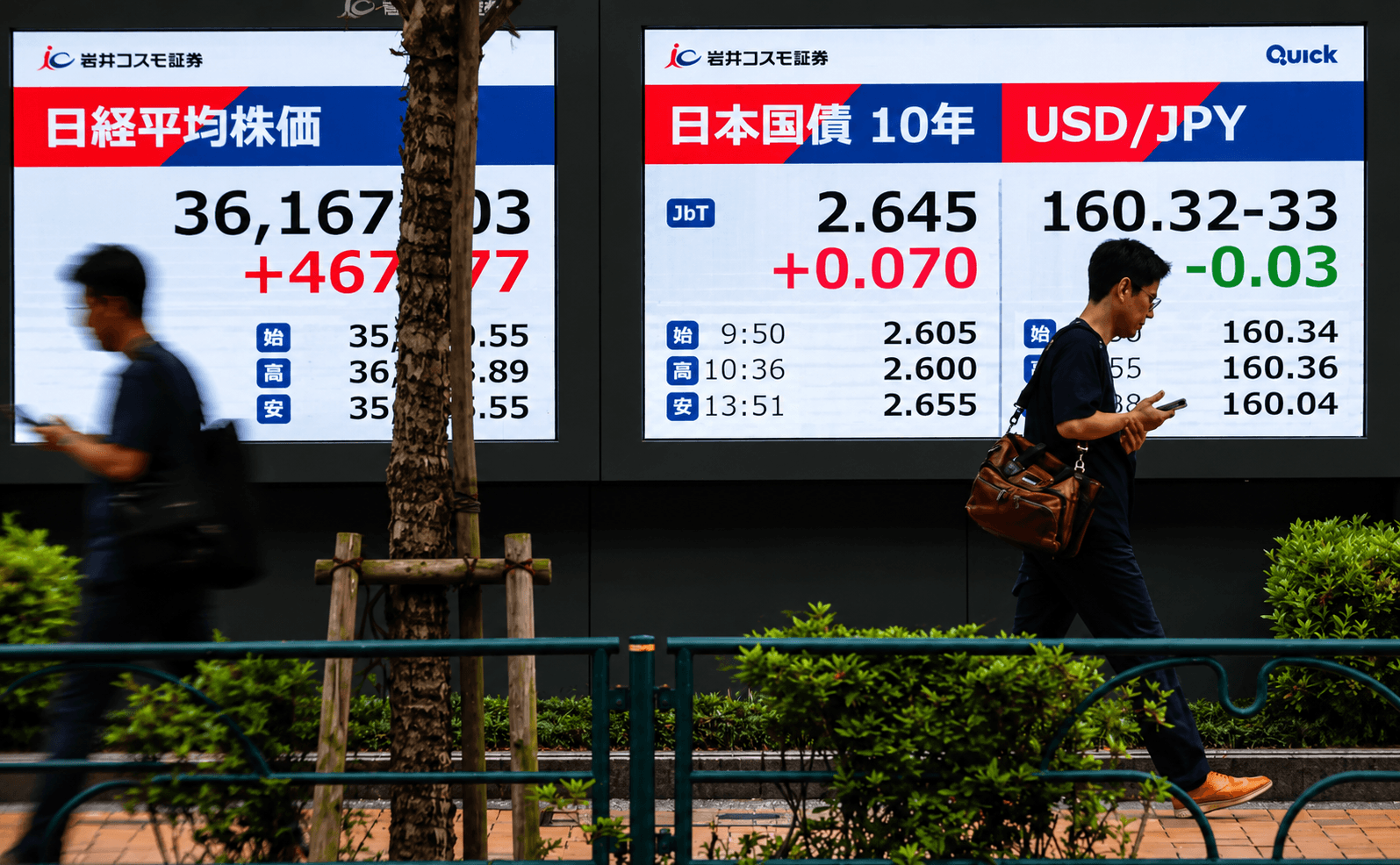
Japan’s bond market is getting some breathing room after a turbulent spell that pushed government borrowing costs to levels not seen in decades. The benchmark 10-year Japanese government bond (JGB) yield has fallen from its recent 30-year high, offering investors some relief as they reassess inflation, government spending and the Bank of Japan’s next move.
Several factors have helped steady the market. Investors have shown renewed interest in Japanese government debt, global market uncertainty has encouraged a shift towards safer assets, and a strong auction of 20-year government bonds has boosted confidence. The government’s approach to managing future debt issuance has also remained in focus.
On 19 October, the 10-year JGB yield fell three basis points to 2.90%. Yields on longer-dated bonds also moved lower, reversing part of the sharp increase seen during the recent global bond sell-off.
By 21 October, the 10-year yield was hovering around 2.90%, below its late-September peak. Even so, borrowing costs remain considerably higher than they were a year ago.
The pullback is welcome news for the government and borrowers, but it does not mean the underlying problems have gone away. Investors are still watching inflation closely, weighing the possibility of further BOJ rate increases and assessing whether government borrowing plans could put renewed pressure on the market.
The key question now is whether Japan’s bond market is entering a more stable period or simply taking a breather before another bout of volatility.
WHAT IS HAPPENING IN JAPAN’S BOND MARKET?
Government bonds are essentially loans that investors make to governments. In return, investors receive interest payments and repayment according to the terms of the securities.
Bond prices and yields move in opposite directions. When demand for bonds increases, their prices generally rise and their yields fall. When investors sell bonds, prices tend to decline and yields increase.
That relationship helps explain Japan’s recent market recovery. As buyers returned to Japanese government debt, bond prices strengthened and yields eased.
The 10-year government bond yield is particularly important because it serves as a benchmark for borrowing costs across the economy. Its movements can influence mortgage rates, corporate financing, investment decisions and the valuation of financial assets.
Japan’s 10-year yield climbed to a 30-year high in late September as a global bond sell-off intensified and investors worried that persistent inflation could keep interest rates higher for longer.
The subsequent decline has eased some of that pressure, although yields remain elevated by Japan’s historical standards.
For years, Japanese borrowing costs remained exceptionally low. The current environment reflects a broader adjustment to higher interest rates rather than a return to the ultra-low-rate conditions that once defined the country’s financial markets.
STRONG BOND AUCTION HELPS RESTORE CONFIDENCE
One of the clearest signs of improving demand came from Japan’s 20-year government bond auction on 20 October.
The auction attracted bids worth 5.84 times the amount of debt offered. That was the highest bid-to-cover ratio since the 20-year bond was introduced in 1987, suggesting investors were more willing to buy long-term Japanese debt at prevailing yields.
Following the auction, the 20-year yield moved lower, while the 10-year yield also eased as market sentiment improved.
Why auction demand matters
Government bond auctions provide a useful snapshot of investor appetite for newly issued debt.
When an auction attracts strong demand, it reassures markets that the government can find buyers at the yields on offer. It can also ease concerns that investors will demand sharply higher returns before agreeing to hold additional debt.
That reassurance is particularly important for Japan, where longer-term yields have faced pressure from inflation concerns and uncertainty about the government’s fiscal plans.
However, one successful auction does not guarantee that demand will remain strong. Future results will depend on interest-rate expectations, inflation, the volume of debt offered and broader market conditions.
For now, the latest figures suggest that investors are not turning away from Japanese government bonds altogether. At current yields, some appear to see an opportunity to secure better returns than were available during the years of near-zero interest rates.
The BOJ’s bond operations remain in focus
The Bank of Japan’s bond-purchase operations are another factor investors are watching as the market settles.
Central bank purchases can support demand for government debt, although their effect depends on the size of the purchases, the maturities targeted and expectations about future monetary policy.
Scheduled BOJ purchases of longer-dated securities have attracted attention during the latest period of market stabilisation.
Still, the central bank’s broader policy direction matters just as much. If investors expect interest rates to rise further, government bond yields could climb again even if auctions continue to attract strong demand.
WHY JAPANESE BOND YIELDS ROSE SO SHARPLY
Japan’s recent bond-market turbulence has not been driven by a single issue. Changing expectations for interest rates, concerns about inflation, government borrowing plans and movements in international markets have all played a part.
1. Expectations of higher interest rates
The Bank of Japan has been moving away from its long-standing ultra-low-interest-rate policy as inflation has become more persistent.
Investors are assessing whether another rate increase could come later this year, with the BOJ’s next scheduled policy meeting set for 29–30 October.
Expectations of higher short-term rates can push longer-term bond yields upwards as well. Investors also face the risk that bonds purchased today could lose market value if yields rise further.
This risk is especially relevant for longer-dated securities, whose prices tend to be more sensitive to changes in interest-rate expectations.
A cautious message from the BOJ could help calm the market if investors interpret it as a sign that further tightening will be gradual. A more hawkish stance, however, could trigger another round of selling.
2. Inflation and energy costs
Inflation remains a major concern for Japanese policymakers and bond investors.
Higher energy and raw-material prices can increase production and transport costs. A weaker yen can add to the pressure by making imported goods more expensive.
Investors generally seek higher returns when they believe inflation could erode the purchasing power of future bond payments. That can push yields higher, particularly on long-term debt.
Japan’s reliance on imported energy makes movements in international oil and gas prices especially important.
If energy costs rise again or the yen weakens sharply, investors may become less confident that inflation will settle towards the BOJ’s target without further policy tightening.
3. Government borrowing and fiscal policy
The government’s borrowing plans are another source of uncertainty.
Investors look beyond the amount of debt being issued. They also consider how the government intends to fund its spending, manage its existing obligations and support economic growth.
Prime Minister Sanae Takaichi has pledged to manage Japan’s debt issuance appropriately, a commitment that has helped reassure investors during the recent volatility.
But markets will want to see how that approach translates into actual spending and financing decisions.
If investors believe borrowing will increase substantially without a credible plan for maintaining fiscal stability, they may demand higher yields to compensate for the additional risk.
GLOBAL MARKETS ARE ALSO INFLUENCING JAPANESE BONDS
Japan’s bond market does not operate in isolation. Movements in US Treasury yields and shifts in global investor sentiment can quickly influence Japanese government debt.
The latest decline in Japanese yields coincided with a move towards safer assets following weakness in US technology stocks. As investors reassessed their exposure to riskier investments, government bonds benefited from renewed interest.
This is a familiar pattern. When uncertainty rises in equity markets, some investors move money into government debt that they consider relatively safe and liquid.
However, bonds do not always benefit when stocks fall. If a market sell-off is driven by fears of rising inflation and higher interest rates, both equities and bonds can come under pressure at the same time.
Why US Treasury yields matter
US Treasury yields are a major reference point for borrowing costs around the world.
When US yields rise sharply, investors may expect higher returns from other government bonds as well. Changes in US yields can also influence currency movements and the relative attractiveness of investments across countries.
When Treasury yields fall, the pressure on other bond markets may ease.
Japan’s recent recovery has benefited from changing global market sentiment, but the outlook remains sensitive to US inflation data, Federal Reserve policy and investment trends in the technology sector.
Could higher Japanese yields bring money back home?
Rising yields in Japan could also change how domestic investors allocate their money.
For years, Japanese investors looked overseas for better returns because domestic interest rates were so low. As yields at home increase, Japanese government bonds may become more attractive compared with some foreign alternatives.
If this shift gathers pace, it could influence international capital flows, including demand for US and European government debt.
Some market analysts have warned that stronger demand for Japanese assets could encourage investors to bring more money home, potentially adding pressure to yields in other markets.
The scale of any shift remains uncertain. Currency-hedging costs, expected returns and global economic conditions will all play a role in determining where investors put their money.
WHAT A CALMER BOND MARKET MEANS FOR JAPAN
The recent decline in yields offers some relief to financial markets, but its effects extend well beyond bond trading.
Government financing
When government bond yields rise, issuing new debt generally becomes more expensive. Existing fixed-rate debt does not immediately cost more to service, but refinancing and new borrowing can gradually reflect higher market rates.
That matters for Japan, which carries a substantial public debt burden.
A more stable bond market gives the government greater certainty when planning its financing needs. However, a few days of lower yields will not erase the longer-term impact of higher borrowing costs.
Businesses and investment
Government bond yields also help determine borrowing costs for businesses.
When benchmark yields rise, companies may have to pay more to finance new factories, equipment, research and expansion. Businesses that rely heavily on borrowing may respond by delaying projects or becoming more cautious about spending.
Lower yields can ease some of that pressure, but the benefit depends on whether the decline lasts and how banks and credit markets pass changes in benchmark rates on to borrowers.
For Japanese companies investing in artificial intelligence, semiconductor manufacturing and industrial automation, financing costs are especially important. These projects often require substantial investment before they begin generating returns.
Households and mortgages
Bond yields can also influence certain mortgage rates and other household borrowing costs.
A sustained rise in yields may gradually make some loans more expensive, while a decline can reduce upward pressure. The effect varies by loan type, with fixed-rate and variable-rate mortgages responding differently to market conditions and BOJ decisions.
Households must also contend with the cost of everyday essentials. Even if bond yields stabilise, higher food, energy and transport prices can continue to put pressure on family budgets.
THE BOJ’S NEXT MOVE COULD SET THE MARKET’S DIRECTION
The Bank of Japan’s policy meeting on 29–30 October is likely to be a major focus for bond investors.
If the central bank holds rates steady and signals that it needs more time to assess the impact of previous increases, the decision could offer some short-term relief.
But if policymakers stress that inflation remains persistent and further tightening is necessary, investors may begin pricing in higher rates again.
For long-term bonds, the distinction between a temporary pause and a lasting shift in policy expectations is crucial. Even if the BOJ leaves rates unchanged at its next meeting, yields could rise if investors believe further increases are coming in the months ahead.
Markets will also examine the central bank’s economic forecasts and its assessment of wages, consumer spending, energy prices and the yen.
Policymakers face a difficult balancing act
The BOJ must keep inflation under control without unnecessarily weakening economic activity.
Investment linked to AI and semiconductors offers some support for Japan’s growth outlook. At the same time, businesses are dealing with higher costs, and households remain sensitive to rising prices and borrowing expenses.
That uneven picture makes monetary policy decisions more complicated.
Tightening too quickly could weigh on consumption and business investment. Moving too slowly could allow inflation and currency pressures to persist, potentially pushing longer-term yields higher.
For investors, the uncertainty means the recent decline in yields should not be mistaken for the start of a steady downward trend.
WHAT COULD TRIGGER ANOTHER BOND SELL-OFF?
Several developments could put Japanese government bonds under renewed pressure.
A more hawkish BOJ: Strong signals that further rate increases are approaching could push short- and long-term yields higher.
Rising energy prices: More expensive oil and gas could lift inflation expectations and squeeze household budgets.
A weaker yen: A sharp fall in the currency could make imports more expensive and strengthen expectations of further monetary tightening.
Higher government borrowing: Concerns about the scale of future debt issuance could prompt investors to demand better returns.
Another global bond sell-off: A sharp rise in US Treasury yields or renewed fears about inflation could spill over into Japan.
Weaker auction demand: If future bond auctions attract fewer bids, concerns about the government’s ability to finance its borrowing needs could return.
Whether the market can maintain its recent stability will depend on how these risks develop and whether investors continue to find Japanese government debt attractive at current yields.
FACT CHECK METER
FACT METER: 98% — YIELD DECLINE AND STRONG AUCTION DEMAND REPORTED; LONG-TERM STABILITY REMAINS UNCERTAIN
STATUS: Japan’s benchmark 10-year government bond yield fell to 2.90% on 19 October, retreating from a 30-year high reached in late September. The decline coincided with a shift towards safer assets, government assurances on debt issuance and strong demand at a 20-year bond auction. The 10-year yield was reported to be holding around 2.90% on 21 October.
CONFIRMED DETAILS
The 10-year JGB yield fell three basis points to 2.90% on 19 October.
The yield had reached a 30-year high during the late-September bond-market sell-off.
Japan’s 20-year government bond auction on 20 October recorded a bid-to-cover ratio of 5.84, the highest since the bond was introduced in 1987.
The 10-year yield remained around 2.90% on 21 October.
Investors continue to monitor BOJ policy expectations, inflation and government borrowing plans.
IMPORTANT DISTINCTIONS
Falling yields generally mean bond prices are rising. They do not mean borrowing costs have returned to historically low levels.
Strong demand at one auction does not guarantee equally strong demand at future auctions.
A market recovery does not mean concerns about inflation or government finances have been resolved.
The future direction of yields will depend on economic data, BOJ policy, government borrowing and global market conditions.
AWX VERDICT: Japan’s bond market has found some support from strong auction demand and a shift towards safer assets. The improvement is encouraging, but it is too early to conclude that the market has entered a sustained recovery. Inflation, monetary policy and fiscal decisions will continue to shape investor sentiment.
WHAT TO WATCH NEXT
The BOJ’s 29–30 October meeting: Watch for changes in the central bank’s language on inflation and the possibility of another rate increase.
The 10-year JGB yield: Whether it holds near 2.90% or begins climbing again will offer clues about investor confidence.
Long-term bond auctions: Demand for 20-year and 30-year securities will show whether buyers remain comfortable holding Japanese government debt.
Government borrowing plans: New details on debt issuance and fiscal policy could influence market sentiment.
The yen: Further weakness could raise import costs and strengthen expectations of tighter monetary policy.
US Treasury yields: Another sharp increase in US borrowing costs could put pressure on Japanese bonds.
Energy prices: Changes in oil and gas prices could affect inflation expectations and the BOJ’s outlook.
Business investment: Financing costs will remain important for companies investing in semiconductors, AI and industrial projects.
Foreign investor demand: Changes in overseas appetite for Japanese government bonds could affect yields and currency markets.
THE AWX BOTTOM LINE
Japan’s bond market is showing signs of relief after a sharp rise in yields unsettled investors and pushed borrowing costs to levels not seen in decades.
Strong demand at a 20-year government bond auction, renewed interest in safer assets and the government’s commitment to managing debt issuance have helped the benchmark 10-year yield retreat to around 2.90%.
But the pressure has not disappeared. Inflation remains a concern, the Bank of Japan could still raise rates further, and the government’s borrowing plans will continue to influence investor expectations.
Japan now faces the challenge of maintaining confidence in its bond market while moving away from years of ultra-low interest rates. For investors, the latest decline in yields is a welcome sign of improving sentiment, but it is not proof that market volatility is over.
The BOJ’s next policy decision and the government’s fiscal choices could determine whether the current calm lasts or gives way to another period of uncertainty.
ATTLAS NEWS | AWX WORLD NEWS
Real Stories. Lasting Impact.




Comments
No comments yet.