

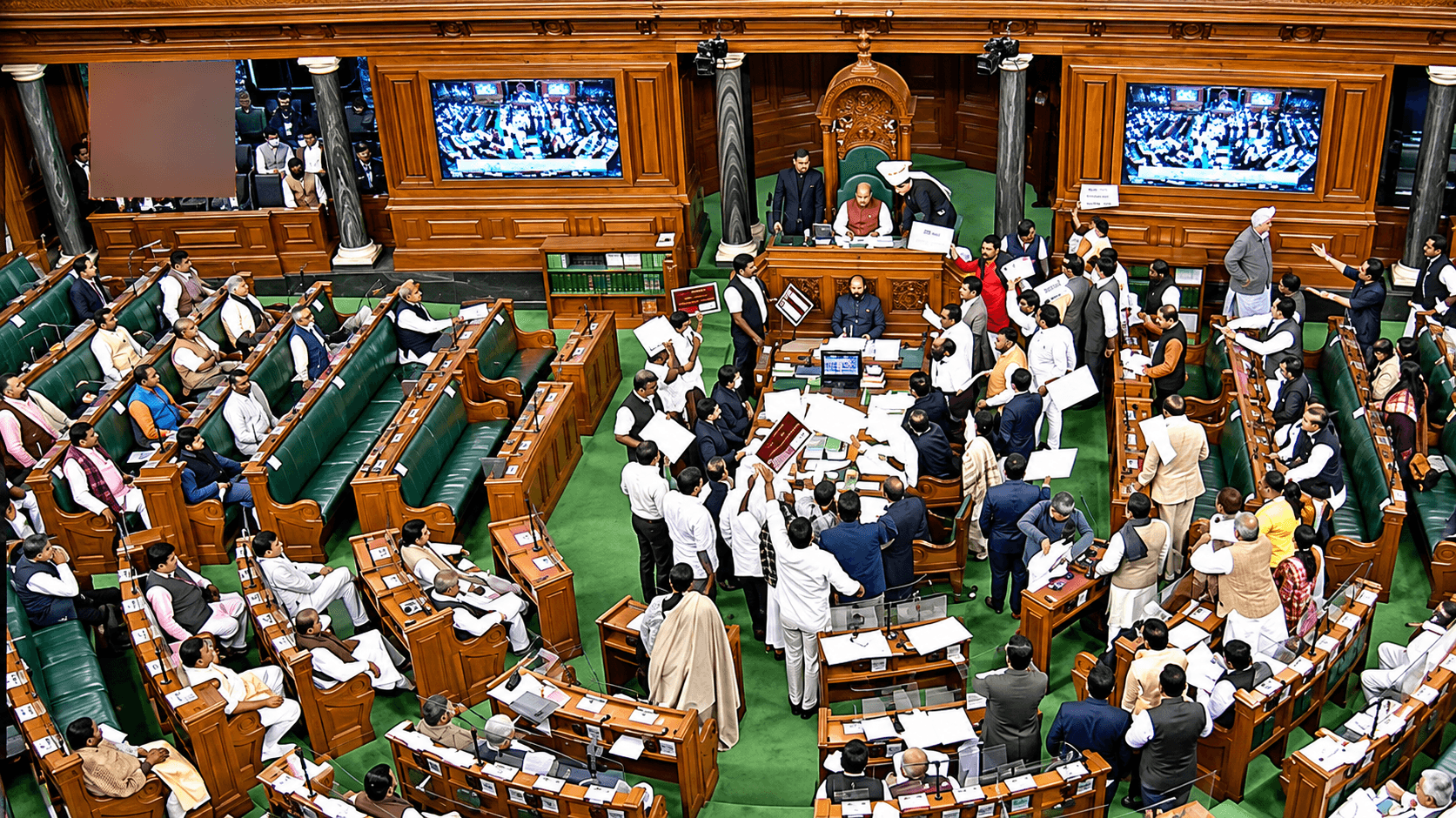
India's Parliament is approaching another politically sensitive period as disagreements over key legislative proposals continue to deepen. Opposition parties have raised objections to several bills, particularly those concerning constituency delimitation, women's reservation, foreign funding regulations and the balance of power between the Centre and the states.
The disagreements could set the stage for another confrontation between the government and opposition when parliamentary proceedings resume.
The Monsoon Session in August was already marked by repeated disruptions, which affected the smooth functioning of both Houses. Although several bills were passed, opposition leaders questioned whether important legislation had received enough time for meaningful debate and scrutiny.
More recently, Congress has raised questions about the government's delay in formally proroguing Parliament. The party has also expressed concern that a special session could be called to advance legislation connected to delimitation. However, the government has not officially confirmed plans for such a session or announced an agenda.
With several proposals still awaiting legislative action, the next phase of parliamentary proceedings could test the government's ability to secure wider political support.
DELIMITATION BILL EMERGES AS A MAJOR POLITICAL FLASHPOINT
The proposed delimitation exercise has become one of the most contentious issues on Parliament's agenda. Delimitation involves redrawing electoral constituency boundaries and can have a significant impact on how states are represented in the Lok Sabha.
The Delimitation Bill, 2026, introduced on April 16, remains listed as pending. Its possible impact on the distribution of parliamentary seats has raised concerns among opposition parties, particularly those representing southern states.
Several southern leaders argue that states which have successfully controlled population growth should not lose political influence because of changes in the distribution of parliamentary seats. They want greater clarity on how representation will be determined and how regional interests will be protected.
The debate is also closely linked to the government's plan to introduce 33% reservation for women in the Lok Sabha and state assemblies from the 2029 general election. The government has sought to connect the implementation of women's reservation with the delimitation process.
An earlier constitutional amendment linked to the exercise was defeated in April, with 298 members voting in favour and 230 against. The result showed that the government had not secured the two-thirds majority required to pass the proposal.
Any renewed attempt will therefore require the government to address concerns raised by opposition parties and build support beyond its existing political base.
FCRA AMENDMENT BILL DRAWS STRONG OPPOSITION
The Foreign Contribution (Regulation) Amendment Bill, 2026, has emerged as another major source of disagreement.
Introduced in the Lok Sabha on March 25, the bill proposes tighter oversight of organisations receiving foreign contributions. One of its most debated provisions would allow an authority to take control of assets belonging to non-profit organisations that lose their registration or licence.
Congress and several other opposition parties have criticised the proposed changes, arguing that the expanded powers could put additional pressure on charities, non-governmental organisations and other civil society groups.
Some political leaders have also raised concerns about the possible impact on minority organisations and the independence of groups working in the social sector.
Congress has called for the bill to be withdrawn or referred to a Joint Parliamentary Committee for a closer examination. NCP-SP leader Supriya Sule has also called for greater scrutiny before the legislation moves forward.
The government has yet to build broad political agreement around the proposal. Unless concerns are addressed, the bill could become another major point of disagreement when Parliament resumes its legislative business.
CORPORATE LAW REFORMS AND OTHER PENDING BILLS FACE SCRUTINY
The government's legislative agenda also includes several proposals covering corporate regulation, education and the administration of Union Territories.
The Corporate Laws (Amendment) Bill, 2026, introduced in March, remains pending. The legislation is part of the government's broader effort to update India's corporate regulatory framework. Its progress will depend on parliamentary scrutiny and the government's response to concerns raised during the legislative process.
The Indian Statistical Institute Bill, 2026, introduced in August, is another proposal awaiting further consideration.
The Union Territories Laws (Amendment) Bill, 2026, also remains on the list of pending legislation.
Although these bills deal with different policy areas, their progress will add to the pressure on Parliament's legislative calendar. Lawmakers will need to balance the government's reform priorities with the time required for detailed discussion and examination.
OPPOSITION QUESTIONS GOVERNMENT'S PARLIAMENTARY STRATEGY
Opposition criticism is increasingly centred on how the government is managing its legislative programme and consulting political parties on major proposals.
Congress leader Jairam Ramesh recently questioned why Parliament had not been formally prorogued following the conclusion of the Monsoon Session on August 13. He suggested that the delay could be connected to discussions about a possible special session to advance delimitation-related legislation.
He also challenged the government to share its proposals with opposition parties before taking major legislative decisions.
Lok Sabha Speaker Om Birla clarified that the decision to convene a special parliamentary session rests with the government rather than the Speaker. Under Article 85 of the Constitution, Parliament is summoned and prorogued by the President on the advice of the government.
As of the latest reports reviewed, no official announcement had been made about a special session. Its possibility therefore remains a matter of political speculation rather than a confirmed decision.
Opposition parties are seeking an all-party meeting and greater consultation before the government moves ahead with contentious proposals. The government, meanwhile, faces pressure to clarify its legislative priorities and the next steps.
MONSOON SESSION DISRUPTIONS RAISE QUESTIONS ABOUT PARLIAMENTARY SCRUTINY
The August Monsoon Session highlighted the growing difficulty of conducting parliamentary business amid political disagreements.
The session concluded on August 13 after 19 sittings spread across 25 days. Twelve bills were passed by both Houses, but repeated disruptions affected the time available for discussion and debate.
According to an ETGovernment report, the Lok Sabha recorded approximately 19% productivity, while the Rajya Sabha recorded around 39%.
Opposition parties criticised the passage of important legislation without sufficient discussion. The government, however, continued to push ahead with its legislative programme.
The session has once again brought attention to the importance of parliamentary committees, detailed debates and proper examination of proposed laws.
With several contentious bills still awaiting consideration, both the government and opposition will face pressure to ensure that Parliament functions effectively and that important legislation receives the scrutiny it deserves.
GOVERNMENT FACES A TEST OF NUMBERS AND POLITICAL CONSENSUS
The challenges facing the government's legislative agenda go beyond political protests and parliamentary disruptions. Constitutional amendments require a special majority, making support from parties outside the ruling alliance particularly important for proposals involving delimitation and constitutional changes.
The opposition's position also presents a complicated picture. Congress and several regional parties have criticised aspects of the delimitation proposals, but political views on women's reservation and other reforms are not entirely uniform.
This means the government cannot assume that its existing parliamentary support will be enough to secure approval for every major proposal.
Opposition parties, meanwhile, will need to maintain a coordinated position while putting forward their own views on electoral representation, federal balance and regulatory oversight.
The coming parliamentary discussions could influence not only the future of individual bills but also the wider political relationship between the government and opposition.
RISKS AND KEY ISSUES TO WATCH
Delimitation controversy: Disagreements over constituency boundaries and state representation could deepen political divisions.
Women's reservation debate: Differences over the implementation process could create further tensions between political parties.
FCRA concerns: Opposition resistance could delay the foreign-funding amendment unless concerns receive further consideration.
Parliamentary disruptions: Repeated protests and adjournments could leave less time for meaningful legislative debate.
Constitutional majority challenge: Major constitutional changes will require support beyond a simple parliamentary majority.
Lack of consultation: Limited engagement with opposition parties could make negotiations over important bills more difficult.
WHAT TO WATCH NEXT
Whether the government announces a special session of Parliament.
Whether an all-party meeting takes place to discuss delimitation-related proposals.
Whether the pending Delimitation Bill, 2026, moves forward for further consideration.
Whether the FCRA Amendment Bill is referred to a parliamentary committee.
Whether the government secures broader political support for its women's reservation plans.
Whether the next parliamentary session allows more time for meaningful debate and legislative scrutiny.
FACT CHECK METER
Editorial confidence: 97%
Strongly supported — based on parliamentary records and reported political statements.
Confirmed details
The Delimitation Bill, 2026, and FCRA Amendment Bill, 2026, remain listed as pending.
The Monsoon Session concluded on August 13 following repeated disruptions.
Twelve bills were passed by both Houses during the Monsoon Session.
Congress has questioned the government's delay in proroguing Parliament.
Important distinctions
A special parliamentary session has not been officially confirmed in the reports reviewed.
Opposition objections do not automatically mean that a bill will be defeated.
Committee referral, parliamentary debate and final passage are separate stages of the legislative process.
AWX VERDICT
The article draws on parliamentary records and reported political developments. The possibility of a major confrontation in Parliament reflects an assessment of the current political situation, not confirmation that a showdown has been officially scheduled.
The 97% figure represents AWX's editorial confidence in the factual reporting. It is not a statistical probability or an official rating.
THE AWX BOTTOM LINE
India's Parliament is entering a politically sensitive phase as the government tries to move forward with its legislative agenda while opposition parties demand greater consultation and scrutiny.
Delimitation, women's reservation and foreign-funding regulation are particularly contentious because their implications go beyond immediate policy changes. They raise wider questions about political representation, the balance of power between the Centre and states, constitutional authority and democratic accountability.
The government will need to demonstrate that its proposals can attract sufficient parliamentary support, while opposition parties will face the challenge of presenting a coordinated and constructive response.
The next parliamentary session could prove an important test of political consensus, legislative transparency and the ability of India's democratic institutions to handle major disagreements through parliamentary debate.
ATTLAS NEWS | AWX WORLD NEWS
Real Stories. Lasting Impact.

Comments
No comments yet.