

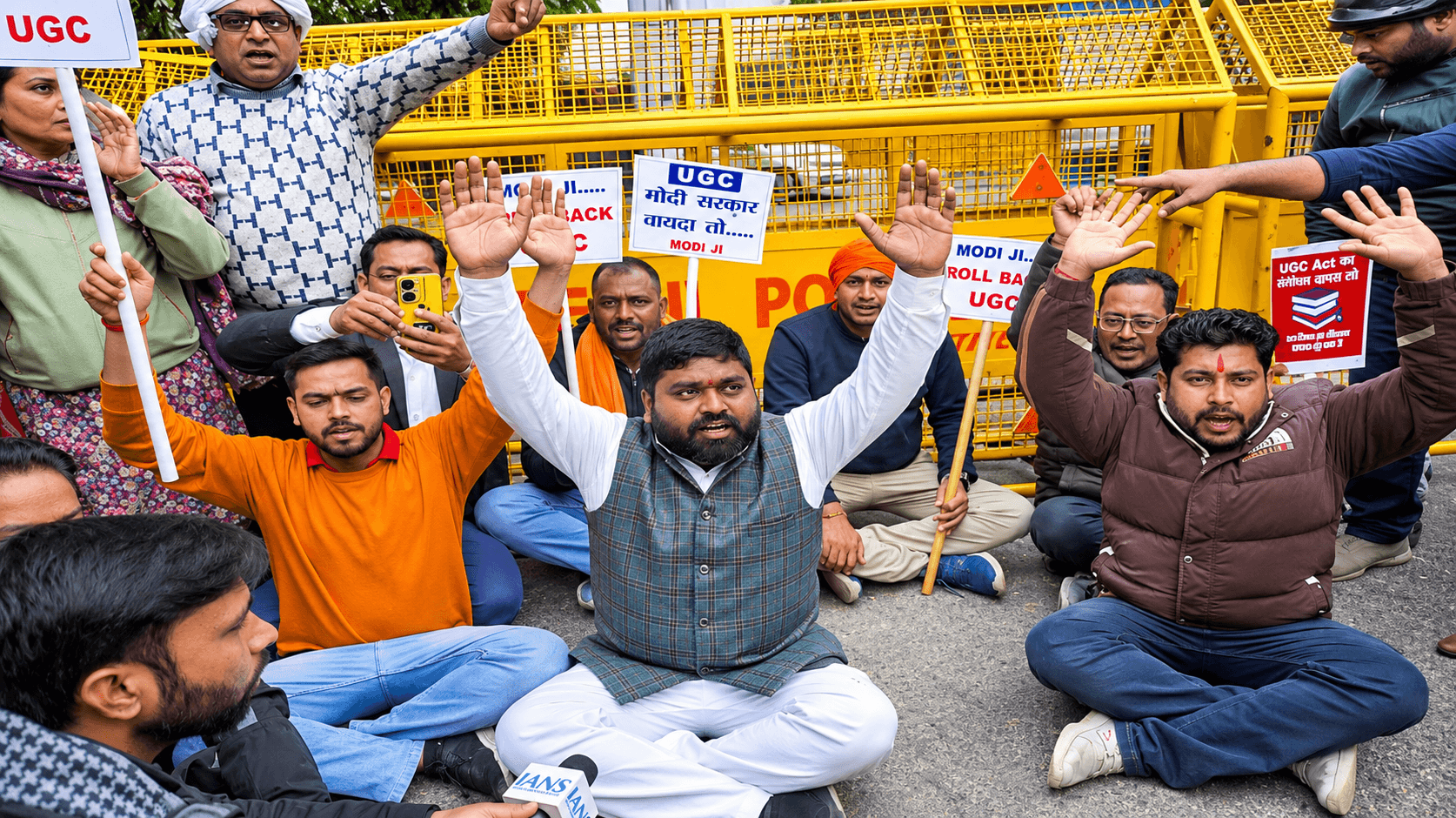
The Rashtriya Swayamsevak Sangh (RSS) has raised concerns over the University Grants Commission's (UGC) new anti-discrimination regulations, calling the 2026 framework unbalanced and asking the central government to reconsider its provisions.
RSS national publicity chief Sunil Ambekar shared the organisation's position during a press conference in Indore on October 31, ahead of its three-day Akhil Bharatiya Karyakari Mandal meeting. He said the RSS had already conveyed its concerns to the authorities and that both the Union government and the UGC were aware of its objections.
Ambekar also referred to the Supreme Court's decision to put the regulations on hold, noting that the matter remained under judicial consideration. He said any revised framework should strike a fair balance and address the concerns of all stakeholders.
The RSS's intervention has added another political dimension to the debate over discrimination in higher education. Although the regulations were introduced to strengthen safeguards against caste-based discrimination, questions have been raised about whether their provisions offer adequate and balanced protection to students from every background.
RSS CALLS FOR A FAIRER UGC FRAMEWORK
Ambekar clarified that the RSS's concerns were focused on the way the UGC regulations had been structured, rather than on the broader objective of preventing discrimination in educational institutions.
He said the organisation had already shared its views with the relevant authorities and expected the government to take them into account while considering any changes.
He also stressed the importance of maintaining social harmony, warning against allowing disagreements over a government policy to create divisions among communities.
The regulations have attracted considerable attention since they were notified in January 2026, with different social and political groups raising questions about their scope and implementation.
The RSS wants the government to develop a framework that addresses discrimination effectively while ensuring that students across communities have confidence in the system.
WHAT DO THE UGC EQUITY REGULATIONS, 2026, INCLUDE?
The UGC (Promotion of Equity in Higher Education Institutions) Regulations, 2026, were notified on January 13, replacing the earlier 2012 framework.
The new rules were intended to strengthen the way universities and colleges handle discrimination complaints and promote equal treatment on campuses.
Some of their key provisions included:
Equal Opportunity Centres: Institutions were required to establish dedicated centres to promote equality and address discrimination-related concerns.
Equity Committees: Universities and colleges were expected to form committees to examine complaints and recommend appropriate action.
Equity Squads: Dedicated teams were proposed to monitor campus environments and help prevent discriminatory practices.
Equity Helplines: Institutions were required to provide accessible complaint-support mechanisms, including round-the-clock assistance.
Equity Ambassadors: Designated representatives would help promote awareness, inclusion and equal treatment.
UGC monitoring: Institutions failing to follow the regulations could face regulatory action, potentially affecting their funding or other benefits.
The intention was to move beyond general guidelines and establish a more structured system for dealing with discrimination in higher education.
However, disagreements emerged over how caste-based discrimination was defined and which groups of students were explicitly covered by the provisions.
WHY ARE THE NEW REGULATIONS FACING OPPOSITION?
Much of the opposition centres on the definition of caste-based discrimination under the new framework.
The disputed provision specifically referred to discrimination against members of Scheduled Castes (SCs), Scheduled Tribes (STs) and Other Backward Classes (OBCs).
Those challenging the regulations argued that the definition did not provide equivalent protection to general-category students facing caste-related harassment.
Petitioners also raised concerns about the absence of clearly defined safeguards against false or malicious complaints. They argued that without adequate procedural protections, the complaint mechanism could potentially be misused.
Supporters of the regulations, however, maintain that caste discrimination remains a serious concern in India's higher education system. They argue that universities need stronger mechanisms to protect students from historically disadvantaged communities and ensure that complaints are addressed properly.
At the heart of the controversy are two equally important questions: how to provide effective protection to students facing discrimination and how to ensure that the system treats every student fairly.
SUPREME COURT PUTS THE REGULATIONS ON HOLD
The dispute reached the Supreme Court shortly after the new regulations were introduced.
On January 29, 2026, a bench headed by Chief Justice Surya Kant and Justice Joymalya Bagchi stayed the implementation of the rules.
During the proceedings, the court raised concerns about certain provisions, including their clarity, the possibility of misuse and their wider implications for equality and social harmony.
The Supreme Court directed that the 2026 regulations remain on hold and that the previous 2012 UGC regulations continue to apply until further orders.
The court also questioned aspects of the framework relating to the definition of caste-based discrimination, ragging, unequal protection and certain campus-related provisions.
It is important to note that the stay was not a final ruling declaring the regulations unconstitutional. The court's observations were preliminary, and the legal questions remained under consideration.
CENTRE REVIEWS THE UGC FRAMEWORK
The Union government informed the Supreme Court on August 20 that it was reconsidering the 2026 regulations.
Solicitor General Tushar Mehta told a three-judge bench led by Chief Justice Surya Kant that the government was reviewing the framework.
The court asked the UGC to submit a detailed response within four weeks, giving the petitioners an additional two weeks to respond.
Senior advocate Indira Jaising, representing petitioners who had sought stronger anti-discrimination protections, requested that the government be given a clear deadline to complete its review.
The government's reconsideration is significant because it must address concerns raised by different groups without weakening the original purpose of the regulations.
As of November 3, no final revised framework or formal decision restoring the 2026 regulations had been confirmed in the reports reviewed.
ROHITH VEMULA AND PAYAL TADVI CASES: THE BACKGROUND
The debate over the new regulations is rooted in a wider discussion about caste discrimination and student safety in higher education.
The legal process gained momentum following a public interest litigation filed in 2019 by Radhika Vemula and Abeda Salim Tadvi, the mothers of Rohith Vemula and Payal Tadvi.
Both students died by suicide after facing allegations of caste-based discrimination at their respective educational institutions.
Their families sought stronger safeguards to prevent discrimination and ensure that universities respond effectively when students raise complaints.
In early 2025, the Supreme Court highlighted the need for a stronger mechanism to address discrimination in higher education. It also allowed stakeholders to submit suggestions as the UGC worked on its revised regulations.
This history is important to understanding the current dispute. The original objective was to improve institutional accountability and ensure that vulnerable students receive meaningful protection.
The present disagreement is therefore less about whether anti-discrimination rules are necessary and more about how they should be designed to remain fair, effective and legally sustainable.
RSS INTERVENTION ADDS A POLITICAL DIMENSION
The RSS's latest remarks come as the UGC regulations have become an increasingly sensitive political issue, particularly with the 2027 Uttar Pradesh Assembly elections approaching.
The proposed rules have drawn protests and objections from several organisations, including groups representing general-category students.
Political reactions have also emerged, with some BJP leaders in Uttar Pradesh expressing concerns about the framework.
The RSS's intervention is noteworthy because it has publicly acknowledged the concerns surrounding the regulations and urged the government to take a more balanced approach.
Its emphasis on social harmony reflects the wider challenge facing policymakers: addressing discrimination without creating uncertainty or a sense of unequal treatment among different groups of students.
For the Centre, the next step will be to find a way forward that protects students' rights, strengthens institutional accountability and maintains public confidence in the regulatory system.
RISKS AND KEY ISSUES TO WATCH
Legal uncertainty: Ongoing Supreme Court proceedings could delay the introduction of a revised anti-discrimination framework.
Student protection: Any weakening of existing safeguards could affect the ability of marginalised students to report discrimination.
Complaint safeguards: Clearly defined procedures will be important to address concerns about false or malicious complaints.
Political pressure: Opposition from social organisations and political groups could make the government's decision more complicated.
Campus tensions: Continued disagreement could deepen divisions among students, faculty members and communities.
Institutional accountability: Universities will need transparent procedures to investigate complaints and ensure fair outcomes.
WHAT TO WATCH NEXT
RSS's further response: Whether the organisation shares additional recommendations on changes to the UGC framework.
Centre's decision: Whether the government announces amendments, a revised framework or a fresh consultation process.
UGC's response: Whether the Commission submits its detailed response to the Supreme Court and outlines additional safeguards.
Supreme Court proceedings: Whether the court issues further directions or sets a timeline for resolving the dispute.
Student organisations: Whether protests and representations from different student groups continue or intensify.
Final regulations: Whether the eventual framework offers fair procedural protection while effectively addressing caste-based discrimination.
FACT CHECK METER
EDITORIAL CONFIDENCE: 98%
Strongly supported — based on reported RSS statements, court proceedings and regulatory developments.
Confirmed details
RSS national publicity chief Sunil Ambekar described the UGC regulations as unbalanced on October 31.
The UGC notified the 2026 Equity Regulations on January 13.
The Supreme Court stayed their implementation on January 29.
The 2012 UGC framework continues to operate in the interim.
The Union government informed the Supreme Court on August 20 that it was reconsidering the regulations.
Important distinctions
The RSS has questioned the balance of the regulations, not rejected the broader objective of preventing discrimination.
The Supreme Court's interim stay does not amount to a final declaration that the regulations are unconstitutional.
The government's decision to reconsider the framework does not mean that the regulations have been formally withdrawn in their entirety.
Concerns about possible misuse have been raised by critics and petitioners; they should not be treated as proof that the system has been misused.
AWX VERDICT
The RSS's intervention has added fresh weight to calls for changes to the UGC's 2026 equity framework. However, the larger challenge remains the same: creating a system that provides meaningful protection against caste-based discrimination while ensuring fair procedures for every student.
The government's next decision, along with the Supreme Court's continued scrutiny, will play a major role in shaping the future of anti-discrimination policies across India's universities and colleges.
The percentage represents AWX editorial confidence in the article's factual reporting. It is not a statistical probability or an official rating.
THE AWX BOTTOM LINE
The RSS's criticism of the UGC Equity Regulations, 2026, has brought a fresh political dimension to an already sensitive debate over campus discrimination and student rights.
Sunil Ambekar's remarks indicate that the organisation wants the Centre to reconsider the framework and ensure that any revised rules maintain fairness and social harmony.
With the Supreme Court's stay still in place and the government reviewing the regulations, universities continue to operate under the earlier 2012 framework for now.
The challenge ahead is to develop a system that protects students from caste-based discrimination, establishes fair procedures for handling complaints and builds confidence among students from all communities.
ATTLAS NEWS | AWX WORLD NEWS
Real Stories. Lasting Impact.


Comments
No comments yet.