

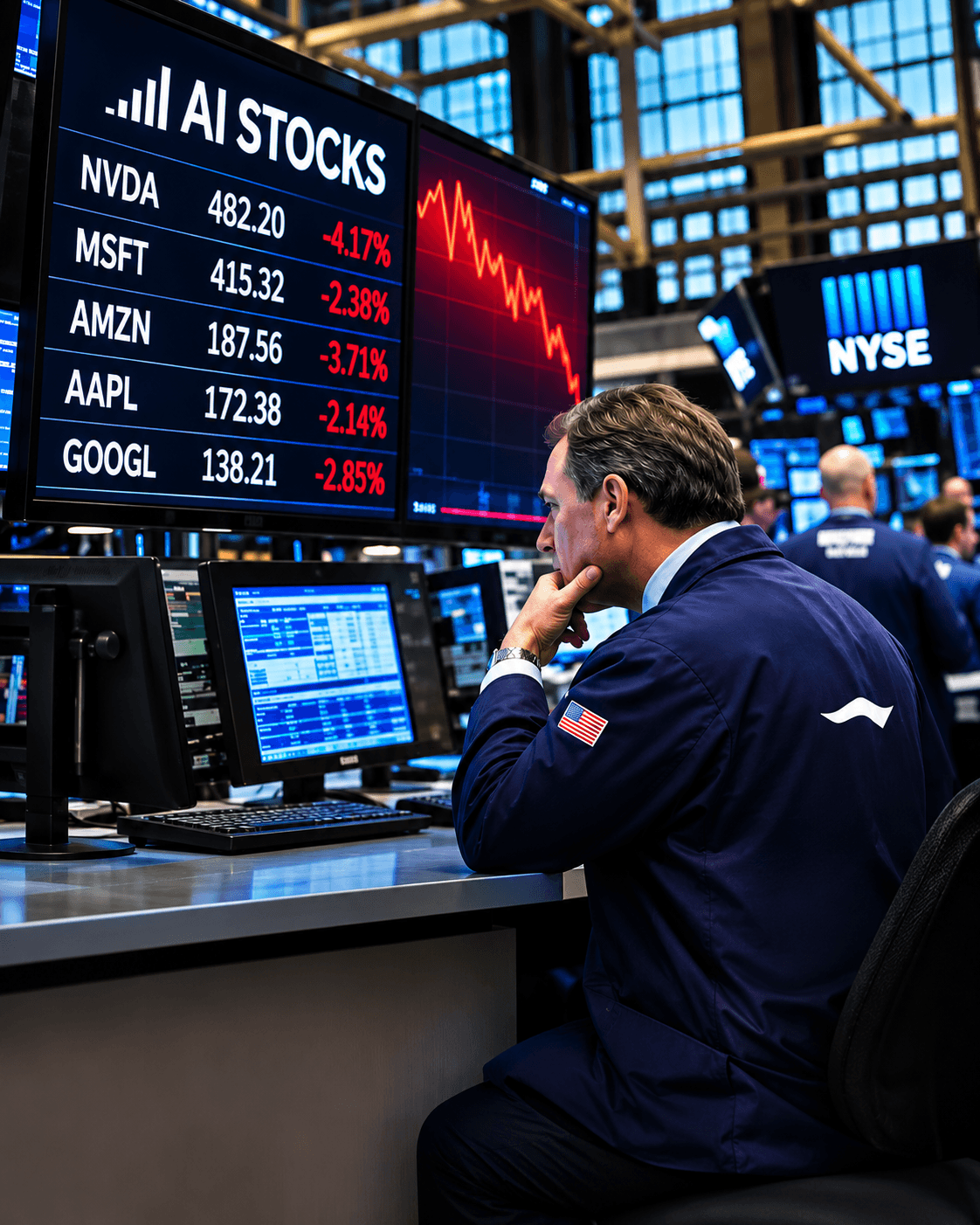
The artificial intelligence industry is entering a more challenging phase as investors take a closer look at the financial and political forces driving its rapid growth. After years of heavy spending on advanced chips, cloud computing and large-scale data centres, technology companies are facing an increasingly important question: will these investments generate enough revenue to justify their enormous costs?
The latest market turmoil followed the November 3 US midterm elections, in which Democrats won control of both chambers of Congress. The results have raised concerns that the new political landscape could bring tougher scrutiny of AI development, data-centre construction, electricity consumption and consumer protection.
On November 5, the Nasdaq Composite plunged 5.52%, marking its steepest single-day decline in 19 months. The S&P 500 fell 4.36%, while the Dow Jones Industrial Average dropped 3.44%. According to Reuters reporting, the selloff wiped out approximately $3 trillion in market value from S&P 500 companies.
The reaction highlights a shift in investor sentiment. AI infrastructure is no longer being viewed as an unquestionable growth opportunity. Investors increasingly want to see whether the billions being poured into computing capacity, energy and advanced technology can translate into sustainable profits.
US ELECTION RESULTS REIGNITE THE REGULATORY DEBATE
The change in political control in Washington has added another layer of uncertainty for technology companies and investors.
Democratic lawmakers have pushed for stronger safeguards around artificial intelligence, including independent testing of AI systems and measures to protect consumers from rising electricity costs linked to energy-intensive data centres.
There are also growing concerns about the environmental impact of large computing facilities, particularly their heavy demand for electricity and water.
The political shift could have significant consequences in states where data-centre construction has expanded rapidly. Texas governor-elect Gina Hinojosa, for instance, has pledged to halt new data-centre construction. Her position has added to concerns among companies planning major infrastructure projects.
However, the election results do not mean that new federal AI restrictions have already become law. For now, the market reaction reflects expectations of possible investigations, new legislative proposals and stronger oversight rather than an existing nationwide regulatory ban.
WALL STREET SELLOFF EXPOSES AI MARKET VULNERABILITY
The sharp decline in technology shares has exposed just how sensitive the AI investment boom has become to political developments and changing market expectations.
The Nasdaq's 5.52% fall on November 5 pushed the index more than 10% below its October record close, placing it in correction territory. Semiconductor companies and businesses connected to data-centre infrastructure were among the hardest hit.
Nvidia shares fell approximately 9.3%, while Advanced Micro Devices (AMD) plunged 17.3%. The Philadelphia Semiconductor Index also dropped 12.2%, reflecting widespread selling across the chip industry.
The pressure extended beyond chipmakers to companies supplying electricity systems, cooling equipment and other infrastructure used by data centres. Investors are increasingly concerned that delays or cuts to construction projects could weaken demand across the wider AI supply chain.
Some market participants believe the selloff may have been excessive. Even so, the scale of the losses suggests that investors are taking a more cautious approach to the industry's growth prospects.
DATA-CENTRE EXPANSION FACES HIGHER COSTS AND LOCAL OPPOSITION
The AI industry relies on an expanding network of data centres to train advanced models, process information and deliver cloud-based computing services.
But building and operating these facilities is becoming increasingly complicated. Data centres require substantial amounts of electricity, water, land and specialised infrastructure. Their rapid expansion has also attracted opposition from local communities worried about higher utility bills, environmental damage, noise and pressure on already limited resources.
Investors are beginning to factor these challenges into their expectations. Stronger local opposition and additional regulatory scrutiny could make new data-centre projects more expensive and delay construction.
Companies may also have to spend more on electricity supplies, water management, environmental compliance and planning approvals.
These additional costs could change the financial calculations behind major AI projects. Developments that once appeared commercially attractive may become less profitable if operating expenses rise or construction schedules fall behind.
The pressure could be particularly difficult for businesses that have taken on significant debt to finance their infrastructure expansion.
INVESTORS QUESTION WHETHER AI SPENDING CAN DELIVER PROFITS
Beyond political and regulatory concerns, the latest market correction reflects a bigger question about the financial future of artificial intelligence: are technology companies spending more than they can realistically earn back?
Major technology firms have committed enormous sums to specialised chips, cloud infrastructure, computing capacity and AI research. While demand for AI services remains strong, the revenue generated by these investments has not always kept pace with the money being spent.
Investors are increasingly looking for clearer evidence that billions of dollars in planned data-centre and semiconductor investments will produce reliable, long-term earnings. Growing reliance on debt to finance infrastructure projects has added to those concerns.
The European Central Bank has also highlighted elevated valuations in AI-related stocks as a potential financial stability risk. On November 2, ECB Vice-President Boris Vujčić said that market corrections involving AI shares were among the developments being monitored by the central bank.
This changing investment climate could benefit companies with stronger cash flows, established customer relationships and practical AI applications that can demonstrate measurable financial returns.
EUROPE AND ASIA FEEL THE IMPACT OF THE AI MARKET CORRECTION
The uncertainty is not limited to the United States. Technology companies and investors across Europe and Asia are also feeling the effects of the market downturn.
European technology shares weakened as investors considered whether tighter US oversight could slow investment in data centres and related infrastructure. Semiconductor equipment manufacturers and companies supplying power systems to large computing facilities also came under pressure.
Asian markets faced an even sharper reaction on November 6. South Korea's KOSPI plunged more than 8% during early trading, triggering a 20-minute trading halt. Japan's Nikkei also fell approximately 5% at one stage.
Chipmakers and data-centre equipment suppliers in South Korea, Taiwan and Japan were particularly exposed because of their close connections to the global AI infrastructure supply chain.
The developments underline how far AI has moved beyond the technology sector. Its investment cycle is now closely linked to global financial markets, industrial production, energy supplies and international trade.
AI INDUSTRY FACES A NEW ERA OF ACCOUNTABILITY
The latest developments could mark an important turning point in how governments, investors and the public assess artificial intelligence.
For years, the industry's main focus was on rapid development, attracting investment and expanding computing capacity. That approach may now give way to a greater emphasis on safety, transparency, energy efficiency, consumer protection and financial accountability.
Governments are likely to face increasing pressure to balance technological progress with safeguards against risks such as algorithmic discrimination, misinformation, privacy violations and the misuse of automated systems.
Technology companies, meanwhile, will need to show that their products deliver genuine economic value while meeting tougher regulatory and environmental expectations.
The challenge will be to introduce meaningful protections without creating unnecessary obstacles to research, innovation and competition.
RISKS AND KEY ISSUES TO WATCH
Stricter AI regulation: New legislation, independent testing requirements and stronger oversight could increase compliance costs for technology companies.
Data-centre investment slowdown: Planning restrictions, community opposition and electricity shortages could delay major infrastructure projects.
Market valuation correction: AI-related shares could face further selling if companies fail to demonstrate sustainable earnings growth.
Rising financing costs: Businesses relying heavily on debt to expand computing infrastructure could face greater financial pressure.
Global technology competition: Differences in AI regulations across the United States, Europe and Asia could create competing standards and complicate international business.
Innovation versus accountability: Governments will need to balance AI safety and consumer protection with the need to maintain technological progress and global competitiveness.
WHAT TO WATCH NEXT
US congressional action: Whether the new Democratic-led Congress introduces legislation targeting AI safety, data-centre development and electricity costs.
Corporate investment plans: Whether major technology companies revise their AI infrastructure budgets following the market correction.
Data-centre approvals: Whether local authorities introduce tighter restrictions on new facilities and energy-intensive projects.
Semiconductor earnings: Whether chipmakers continue reporting strong demand despite growing investor concerns about future AI spending.
European regulatory response: Whether European authorities introduce additional requirements affecting AI companies and infrastructure operators.
Global market recovery: Whether technology stocks regain investor confidence or face further losses as regulatory and profitability concerns develop.
FACT CHECK METER
Editorial confidence: 97%
Confirmed details
The Nasdaq fell 5.52% on November 5, its steepest daily decline in 19 months.
The S&P 500 dropped 4.36%, while the Dow declined 3.44%.
Nvidia and AMD suffered substantial losses during the technology selloff.
Investors are increasingly concerned about potential AI regulation, data-centre construction costs and uncertain investment returns.
The ECB has identified elevated AI stock valuations as a potential financial stability risk.
Important distinctions
Proposed AI restrictions should not be confused with legislation that has already been enacted.
The market decline reflects several factors, including political uncertainty, borrowing costs and concerns about AI profitability.
The correction does not mean that long-term demand for artificial intelligence is disappearing.
AWX VERDICT
The AI industry is entering a more demanding phase, where rapid expansion must be backed by measurable returns, responsible development and greater accountability. Regulatory uncertainty has added pressure to an already volatile market, but the technology's long-term potential remains significant.
The percentage represents AWX editorial confidence in the article's factual reporting, not a statistical probability or official rating.
THE AWX BOTTOM LINE
The artificial intelligence boom is facing a major test of financial and political confidence. Growing demands for regulation, public resistance to data-centre expansion and questions about the returns on massive infrastructure investments are changing the way investors view the industry.
The latest Wall Street selloff shows that even the world's largest technology companies are not immune when market expectations begin to outpace financial performance.
However, this does not necessarily signal the end of the AI revolution. Instead, the industry could be moving into a phase where sustainable business models, responsible innovation, energy efficiency and regulatory compliance matter just as much as technological breakthroughs.
Ultimately, the next chapter of AI development will depend on whether companies can turn ambitious investment plans into profitable, reliable and socially responsible technologies.
ATTLAS NEWS | AWX WORLD NEWS
Real Stories. Lasting Impact.



Comments
No comments yet.