

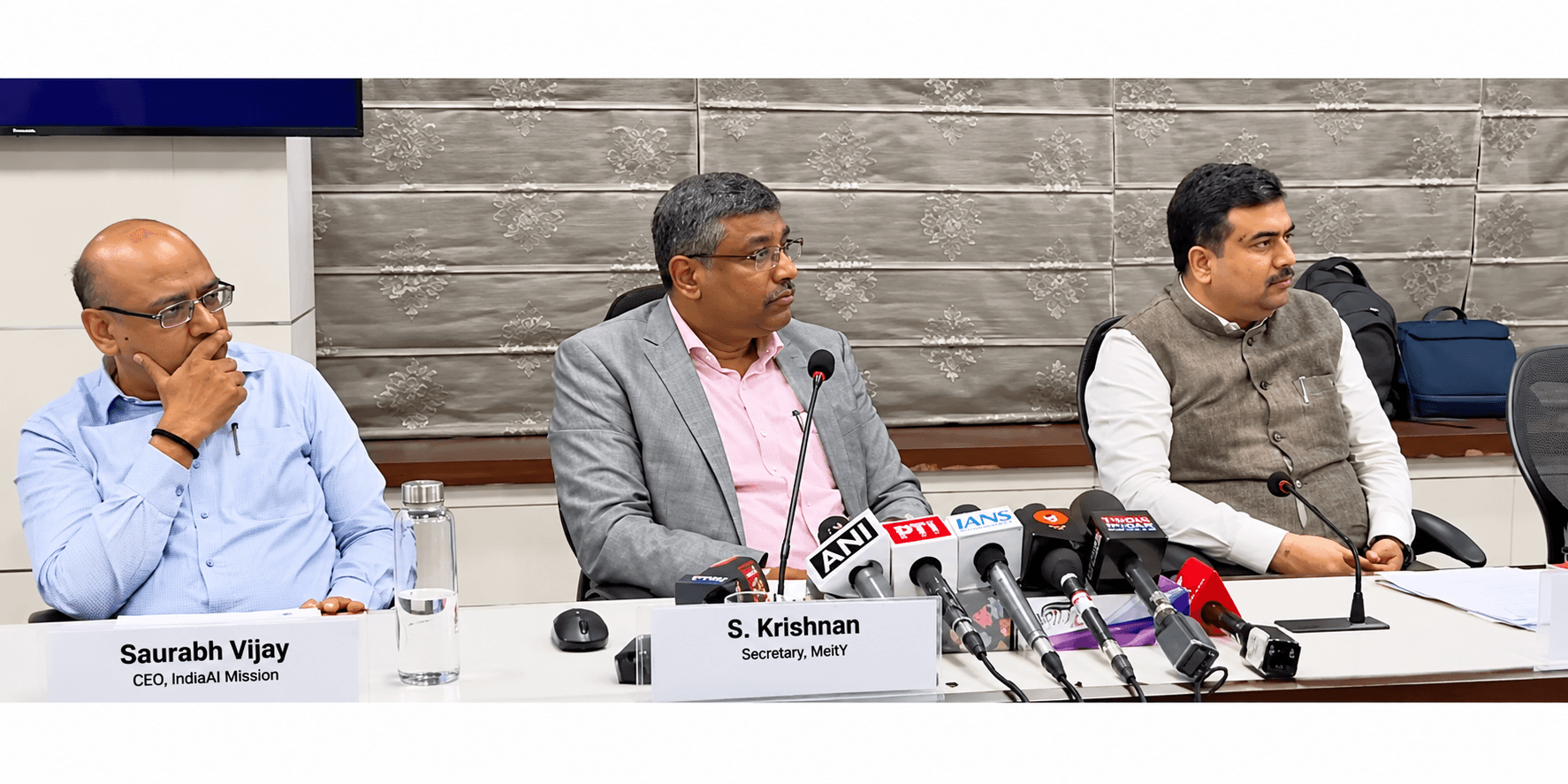
India is making fresh progress in its efforts to build a stronger domestic artificial intelligence ecosystem. On 3 November 2026, the government unveiled three indigenous foundation models under its IndiaAI Mission, marking another step towards developing AI technologies tailored to the country's needs.
The Ministry of Electronics and Information Technology (MeitY) introduced EKA-1, developed by Soket Labs Technology and Research, along with Dhīr 2B and Dhīr 5B, developed by ZenteiQ AiTech Innovations.
The announcement took place in New Delhi in the presence of MeitY Secretary S. Krishnan and senior officials from the ministry and IndiaAI. All three models were developed under the Foundation Models programme of the IndiaAI Innovation Centre, which supports Indian companies and research teams working on advanced AI technologies.
The initiative reflects a broader shift in India's approach to artificial intelligence. Rather than relying entirely on models developed overseas, the country wants to build systems that understand its languages, serve local industries and address its strategic requirements.
EKA-1 — A HOMEGROWN AI MODEL WITH MULTILINGUAL CAPABILITIES
Among the three launches, EKA-1 stands out for its size and extensive language support.
Developed by Soket Labs, the model has 26.3 billion parameters and was trained on approximately 7.5 trillion tokens. It supports all 22 scheduled Indian languages, along with English, making it particularly relevant to India's diverse linguistic environment.
EKA-1 has been designed to handle a range of tasks, including:
Mathematical problem-solving and reasoning.
Software development and coding.
Complex, multistep tasks.
Agent-based AI applications.
Banking and financial services.
Cybersecurity-related applications.
Soket Labs describes EKA-1 as an open, sparse hybrid language model. Its development focuses on applications that require strong language understanding, specialised knowledge and the ability to handle complex tasks.
This could make the model useful in sectors such as financial services, where AI systems need to work with technical information while supporting India's multilingual requirements.
The project also received support through the IndiaAI Mission, including access to subsidised national computing infrastructure.
DHĪR 2B AND DHĪR 5B — AI BUILT FOR SECURE AND OFFLINE ENVIRONMENTS
ZenteiQ AiTech Innovations has introduced Dhīr 2B and Dhīr 5B as open-source multilingual AI assistants, with a particular focus on secure deployment and practical applications.
One of their key features is the ability to operate in on-premise environments, reducing the need for continuous reliance on cloud-based services.
The models support English and 10 Indian languages and are designed for tasks involving document processing, information retrieval and automated knowledge-based services.
Their potential applications include:
Defence and sensitive government operations.
Industrial automation and engineering.
Educational institutions and research organisations.
Enterprise document processing.
Knowledge management and information retrieval.
Public services in areas with limited internet connectivity.
According to ZenteiQ, the models can operate across different computing platforms, including GPUs and TPUs. Their lightweight architecture is also intended to support deployment on compatible mobile devices.
This approach could be particularly useful for organisations handling confidential information. Running AI systems locally gives them greater control over data and reduces their dependence on external cloud infrastructure.
For defence, government and industrial users, the ability to work in restricted or offline environments could be an important advantage.
INDIAAI MISSION GIVES HOMEGROWN INNOVATION A BOOST
The launch of these models is part of the government's wider IndiaAI Mission, which received Union Cabinet approval on 7 March 2024.
The mission aims to strengthen India's AI ecosystem through investments in computing infrastructure, research, innovation, datasets, skill development and responsible AI adoption.
Soket Labs and ZenteiQ were selected under the IndiaAI Innovation Centre's Foundation Models programme. Through this initiative, the developers received access to subsidised national computing resources, along with support for additional research expenses.
Such assistance matters because building foundation models requires considerable investment. Developers need access to powerful computing systems, large training datasets and specialised engineering talent.
By supporting domestic companies and research teams, the government hopes to encourage more Indian-developed AI technologies that can serve local industries and compete in international markets.
The broader objective is to ensure that India does not remain only a consumer of global AI products but also becomes a stronger contributor to their development.
AIKOSH COULD MAKE INDIGENOUS MODELS MORE ACCESSIBLE
Making advanced AI technology available to a wider group of users will be an important part of the IndiaAI Mission.
Platforms such as AIKosh are expected to help researchers, students, start-ups and businesses access datasets, AI models and other development resources.
The government has indicated that EKA-1 and the Dhīr models can be made available through such platforms, giving developers an opportunity to explore their capabilities and build applications around them.
Wider access could encourage universities, start-ups and established companies to experiment with Indian-language AI tools, enterprise automation and locally deployed systems.
However, accessibility will be only one part of the equation. Licensing conditions, technical documentation, deployment requirements and the actual availability of the models will also determine how easily developers can use them.
TECHNOLOGICAL AUTONOMY BECOMES A STRATEGIC PRIORITY
Artificial intelligence is no longer just another emerging technology. It is increasingly connected to national security, economic competitiveness and the future of digital infrastructure.
Governments around the world are investing heavily in foundation models, advanced computing facilities and specialised AI systems. A major reason is the desire to reduce dependence on external technology providers.
India's latest initiative follows a similar direction.
Homegrown AI models could give Indian organisations more control over how their data is processed while allowing them to develop applications suited to local languages, regulations and business requirements.
The offline and on-premise capabilities of the Dhīr models are particularly relevant in environments where internet connectivity or access to external cloud services may be restricted.
MeitY Secretary S. Krishnan has highlighted the importance of indigenous AI development in strengthening India's technological and strategic autonomy while improving productivity across government, industry, research and education.
Still, developing domestic AI models is only one part of achieving technological independence. India will also need continued progress in advanced chips, computing infrastructure, training data and specialist research capabilities.
INDIA'S AI INDUSTRY ENTERS A NEW PHASE
The introduction of EKA-1, Dhīr 2B and Dhīr 5B highlights the different approaches emerging within India's artificial intelligence industry.
While EKA-1 focuses on multilingual reasoning, mathematics, coding and specialised enterprise applications, the Dhīr models place greater emphasis on lightweight deployment, document-based automation and secure local operation.
This distinction is important because different industries have different AI requirements. A model designed for complex reasoning may not necessarily be the best choice for offline document processing or specialised industrial applications.
For Indian businesses, these developments could open new possibilities in banking, education, manufacturing, cybersecurity and public administration.
Start-ups and research institutions may also find opportunities to build specialised applications using these models as a foundation.
However, the real test will come through practical use. Independent evaluations, real-world deployments and feedback from organisations will help establish how well the models perform beyond their initial launch.
RISKS AND KEY ISSUES TO WATCH
Despite the progress, several challenges will influence the long-term success of India's homegrown AI models.
Model performance: Independent benchmarks will be needed to assess reasoning, coding, accuracy and reliability.
Data quality: Consistent performance across Indian languages will depend on access to high-quality and representative training data.
Computing infrastructure: Continued investment in advanced computing resources will be essential for developing more powerful models.
Data security: Local deployment can improve control over information, but organisations will still need protection against cyberattacks, misuse and data leakage.
Commercial adoption: The models must demonstrate practical benefits for businesses, government departments and educational institutions.
Global competition: Indian developers will face competition from international AI companies with considerably larger financial and technical resources.
Responsible AI: Transparency, privacy protection, bias testing and safeguards against inaccurate outputs will remain essential for building public trust.
WHAT TO WATCH NEXT
The launch is an important beginning, but several developments will determine how quickly these models gain wider acceptance.
AIKosh availability: Further details on public access for researchers, developers and businesses.
Independent evaluations: Benchmark results covering multilingual performance, reasoning and specialised applications.
Enterprise adoption: Initial deployments across banking, cybersecurity, defence, education and government services.
Indian-language AI: Improvements in accuracy and performance across regional languages.
Domestic investment: Further government and private-sector funding for Indian AI developers and research teams.
Global competitiveness: Whether these homegrown models can establish a meaningful presence in international AI markets.
FACT CHECK METER
Editorial confidence: 99%
Strongly supported by reported Ministry of Electronics and Information Technology information.
Key details confirmed:
Three indigenous foundation models were unveiled on 3 November 2026.
EKA-1 was developed by Soket Labs.
Dhīr 2B and Dhīr 5B were developed by ZenteiQ AiTech Innovations.
EKA-1 has 26.3 billion parameters and was trained on approximately 7.5 trillion tokens.
EKA-1 supports all 22 scheduled Indian languages and English.
The Dhīr models support English and 10 Indian languages.
All three models were developed under the IndiaAI Mission.
Important distinctions:
The launch does not necessarily mean widespread commercial adoption has already taken place.
Supporting a language does not guarantee the same level of accuracy across every language.
Independent benchmark results and real-world deployments will be important in assessing the models' actual capabilities.
The 99% figure represents AWX editorial confidence in the factual reporting presented here. It is not a statistical probability or an official government rating.
AWX VERDICT
India's introduction of EKA-1 and the Dhīr models marks a meaningful step in the country's efforts to build its own artificial intelligence capabilities.
Their multilingual features and different deployment approaches could give Indian businesses, government departments and research institutions more options when adopting AI. The emphasis on secure, locally operated systems is particularly relevant for sectors handling sensitive information.
However, the announcement is only the beginning. The models will need to prove their reliability, security and practical value through independent testing and wider adoption.
If supported by continued investment in research, computing infrastructure and skilled talent, India's homegrown AI ecosystem could become an increasingly important part of the global technology landscape.
THE AWX BOTTOM LINE
India's latest AI launches reflect a growing ambition to develop technology at home rather than depend entirely on solutions created elsewhere.
EKA-1 brings a focus on multilingual reasoning, mathematics and coding, while Dhīr 2B and Dhīr 5B are designed around secure, locally deployable AI applications.
Together, the three models offer different possibilities for sectors such as banking, education, defence, government and manufacturing.
The bigger challenge now is turning this technological progress into practical results. Continued research, investment in computing infrastructure, responsible development and successful real-world deployment will determine whether these models can help India become a stronger global AI player.
ATTLAS NEWS | AWX WORLD NEWS
Real Stories. Lasting Impact.



Comments
No comments yet.