

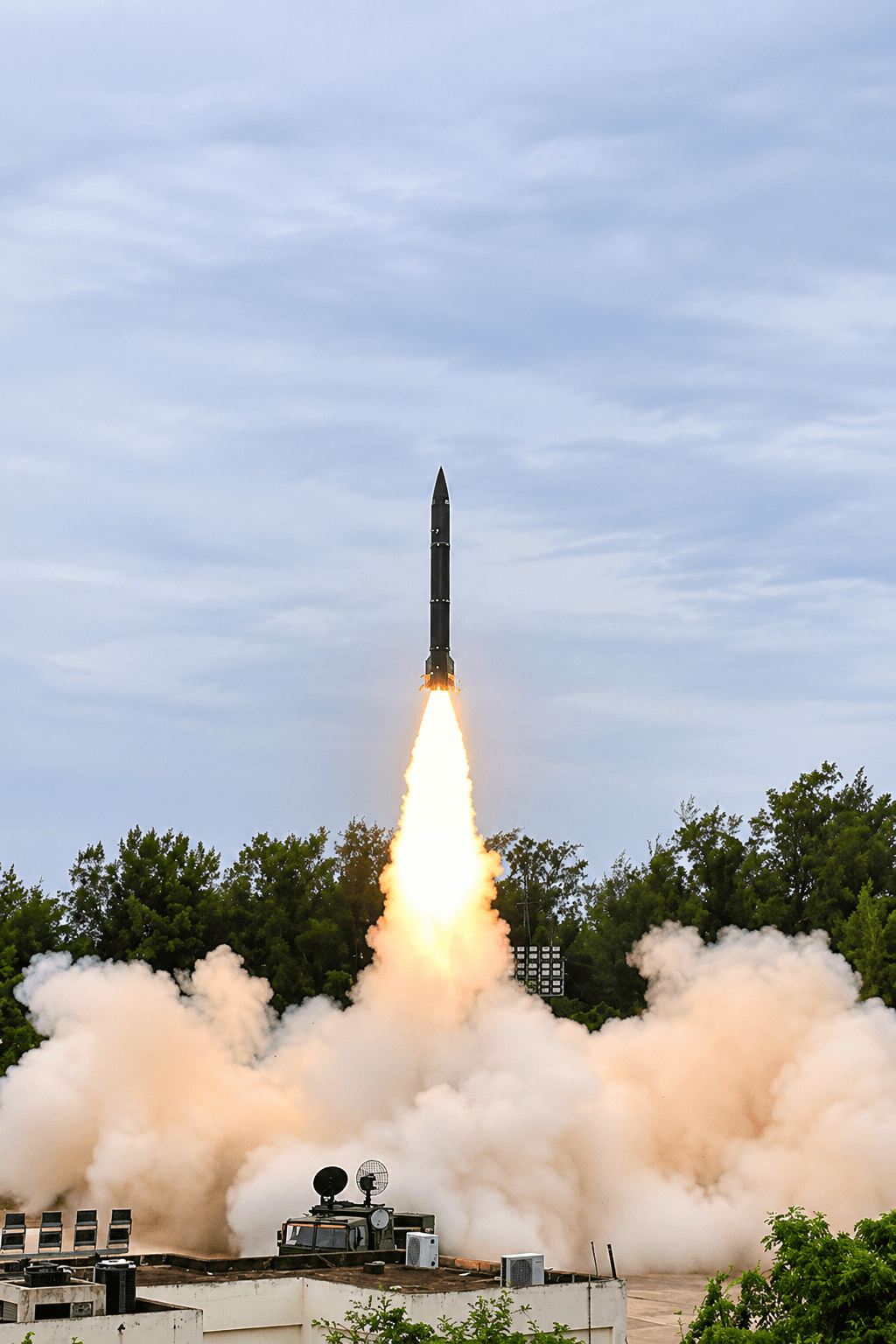
India's efforts to strengthen its indigenous defence capabilities have received another boost following reports of a successful test of the Pralay surface-to-surface quasi-ballistic missile at the Integrated Test Range in Chandipur, Odisha.
According to Akashvani News, the missile was launched from Launch Complex-Three and successfully engaged two simulated targets at a reported distance of around 500 kilometres. The trial demonstrated the missile's flight performance and target-engagement capabilities.
The reported test is another step in the ongoing development of Pralay, a missile designed to give India's armed forces greater flexibility in carrying out precision strikes. It also reflects the country's broader push to develop advanced military technology through domestic research and manufacturing.
However, the specific details of this latest trial have not yet been independently corroborated by a corresponding Ministry of Defence announcement in the sources reviewed.
PRALAY — A MAJOR STEP IN INDIA'S INDIGENOUS MISSILE PROGRAMME
Pralay is an indigenously developed, solid-propellant, surface-to-surface quasi-ballistic missile designed to strike a range of military targets.
What makes the missile different from conventional ballistic systems is its ability to manoeuvre during flight. Rather than following an entirely predictable trajectory, it can adjust its flight path, potentially making interception more challenging for opposing air defence systems.
The missile is reported to have a range of approximately 150 to 500 kilometres and can carry different types of warheads. Its solid-fuel propulsion and mobile-launch configuration also offer greater flexibility during military operations.
These features make Pralay an important part of India's growing conventional missile capabilities, particularly as the country looks to strengthen its precision-strike options.
CHANDIPUR TRIAL ADDS TO INDIA'S MISSILE TESTING EFFORTS
The reported launch from Chandipur, along Odisha's eastern coastline, marks another development in the Pralay testing programme.
According to the latest report, the missile engaged two simulated targets at a distance of approximately 500 kilometres. More than 2,500 residents from nearby villages were also reportedly evacuated temporarily as a safety measure ahead of the trial.
The Integrated Test Range at Chandipur plays an important role in India's missile development programme. It provides the infrastructure needed to monitor launches, track missile performance and assess test results.
While the reported outcome is encouraging, detailed technical findings from this particular trial are still awaited. An official statement from DRDO or the Ministry of Defence would provide greater clarity on its results.
DRDO AND INDIAN INDUSTRY DRIVE MISSILE DEVELOPMENT
Pralay has been developed by Hyderabad-based Research Centre Imarat, with contributions from several DRDO laboratories and Indian defence industry partners.
Key organisations involved in the programme include:
Defence Research and Development Laboratory (DRDL).
Advanced Systems Laboratory (ASL).
Armament Research and Development Establishment (ARDE).
High Energy Materials Research Laboratory (HEMRL).
Defence Metallurgical Research Laboratory (DMRL).
Terminal Ballistics Research Laboratory (TBRL).
Bharat Dynamics Limited (BDL).
Bharat Electronics Limited (BEL).
The programme highlights the importance of collaboration between government research institutions and domestic manufacturers in developing advanced defence systems.
The involvement of Indian companies also supports the growth of local manufacturing capabilities and helps build a more reliable domestic supply chain for critical military technologies.
PREVIOUS SUCCESSFUL TESTS BUILD CONFIDENCE
The latest reported trial follows several officially documented tests that have helped establish the Pralay missile's capabilities.
On 28 and 29 July 2025, DRDO successfully conducted two consecutive flight tests from Dr APJ Abdul Kalam Island off the Odisha coast. According to the Ministry of Defence, these trials validated the missile's maximum and minimum range capabilities. Both missiles followed their intended trajectories and met the prescribed test objectives.
Earlier, on 31 December 2025, DRDO carried out a successful salvo launch of two Pralay missiles in quick succession from the same launcher.
The Ministry of Defence confirmed that both missiles followed their planned trajectories and successfully met the flight-test objectives.
These trials represented important milestones in the missile's development and evaluation process, bringing it closer to potential induction into India's armed forces.
STRATEGIC IMPORTANCE FOR INDIA'S DEFENCE
Pralay could strengthen India's conventional deterrence by providing the armed forces with another option for engaging important military targets.
Its reported operational range, mobile-launch capability and manoeuvrable flight profile offer flexibility in responding to different battlefield requirements. These characteristics are particularly relevant as modern military operations increasingly depend on precision, speed and the ability to overcome sophisticated defence systems.
The programme also reflects India's wider strategy of maintaining credible conventional defence capabilities while investing in homegrown military technology.
However, successful flight tests do not automatically mean that a missile has entered operational service. Further evaluations, procurement decisions and formal induction arrangements remain important steps in the process.
MAKE IN INDIA GAINS MOMENTUM IN MISSILE TECHNOLOGY
Pralay is also part of the wider ambition behind the Make in India and Aatmanirbhar Bharat initiatives.
Developing advanced missile systems within the country can strengthen India's defence research ecosystem, improve manufacturing expertise and create new opportunities for domestic engineering and electronics companies.
The participation of DRDO laboratories, public-sector defence manufacturers and other Indian industry partners demonstrates how government-led research can translate into sophisticated military technology.
Continued investment in such programmes could help India reduce its dependence on overseas suppliers while gaining greater control over critical defence technologies.
The long-term goal extends beyond developing individual weapons. India is working towards building a stronger domestic defence industry capable of designing, testing, manufacturing and maintaining advanced military systems.
RISKS AND KEY ISSUES TO WATCH
Official confirmation: A statement from DRDO or the Ministry of Defence would help establish the precise results of the latest reported trial.
Operational readiness: Further technical evaluations and user trials will be important before the missile enters full service.
Production capacity: Domestic manufacturers will need to maintain consistent quality and meet future production requirements.
Technology development: Improvements in guidance, navigation, accuracy and reliability will remain important.
Defence integration: The missile will need to be effectively integrated into the armed forces' existing operational structures.
Regional security: The development of advanced conventional missile systems will continue to influence the wider regional security environment.
WHAT TO WATCH NEXT
DRDO announcement: Whether an official statement provides additional information about the November 2026 trial.
Technical evaluation: Further details about flight performance and target-engagement results.
Induction timeline: Updates on the missile's progress towards formal entry into service.
Production plans: Developments involving Bharat Dynamics Limited and other domestic manufacturing partners.
Military deployment: Further information on how the Army and Air Force intend to use the missile system.
Future trials: Additional tests to demonstrate the missile's reliability and operational readiness.
FACT CHECK METER
Editorial confidence: 90%
Latest test reported; independent official confirmation of the specific trial remains pending in the sources reviewed.
CONFIRMED BACKGROUND
Pralay is an indigenous quasi-ballistic missile developed by DRDO.
Officially documented successful trials took place in July and December 2025.
The missile uses solid-propellant propulsion and modern guidance and navigation systems.
Research Centre Imarat and several DRDO laboratories contributed to its development.
LATEST REPORTED DEVELOPMENTS
Akashvani News reported a successful Pralay test from Chandipur in November 2026.
The report described the engagement of two simulated targets at a distance of approximately 500 kilometres.
The specific results have not yet been independently corroborated by an official Ministry of Defence announcement in the sources reviewed.
AWX VERDICT
The reported Pralay trial marks another potentially important step in India's indigenous missile development programme. While the reported results are encouraging, the exact outcome of the latest test should be treated as reported information until DRDO or the Ministry of Defence releases further technical details.
The percentage represents AWX's editorial confidence in the article's factual reporting. It is not a statistical probability or an official rating.
THE AWX BOTTOM LINE
The reported Pralay missile test highlights India's continued efforts to strengthen its domestic defence capabilities and develop advanced military technology.
With its mobile-launch configuration, solid-propellant propulsion and ability to manoeuvre during flight, Pralay could become an important component of India's conventional missile arsenal.
The next key milestone will be official confirmation of the latest trial results, followed by further progress towards operational induction.
Beyond its military significance, the programme also demonstrates India's growing focus on domestic research, manufacturing and technological self-reliance. It is another example of how indigenous defence development is becoming an important part of the country's long-term security strategy.
ATTLAS NEWS | AWX WORLD NEWS
Real Stories. Lasting Impact.

Comments
No comments yet.