

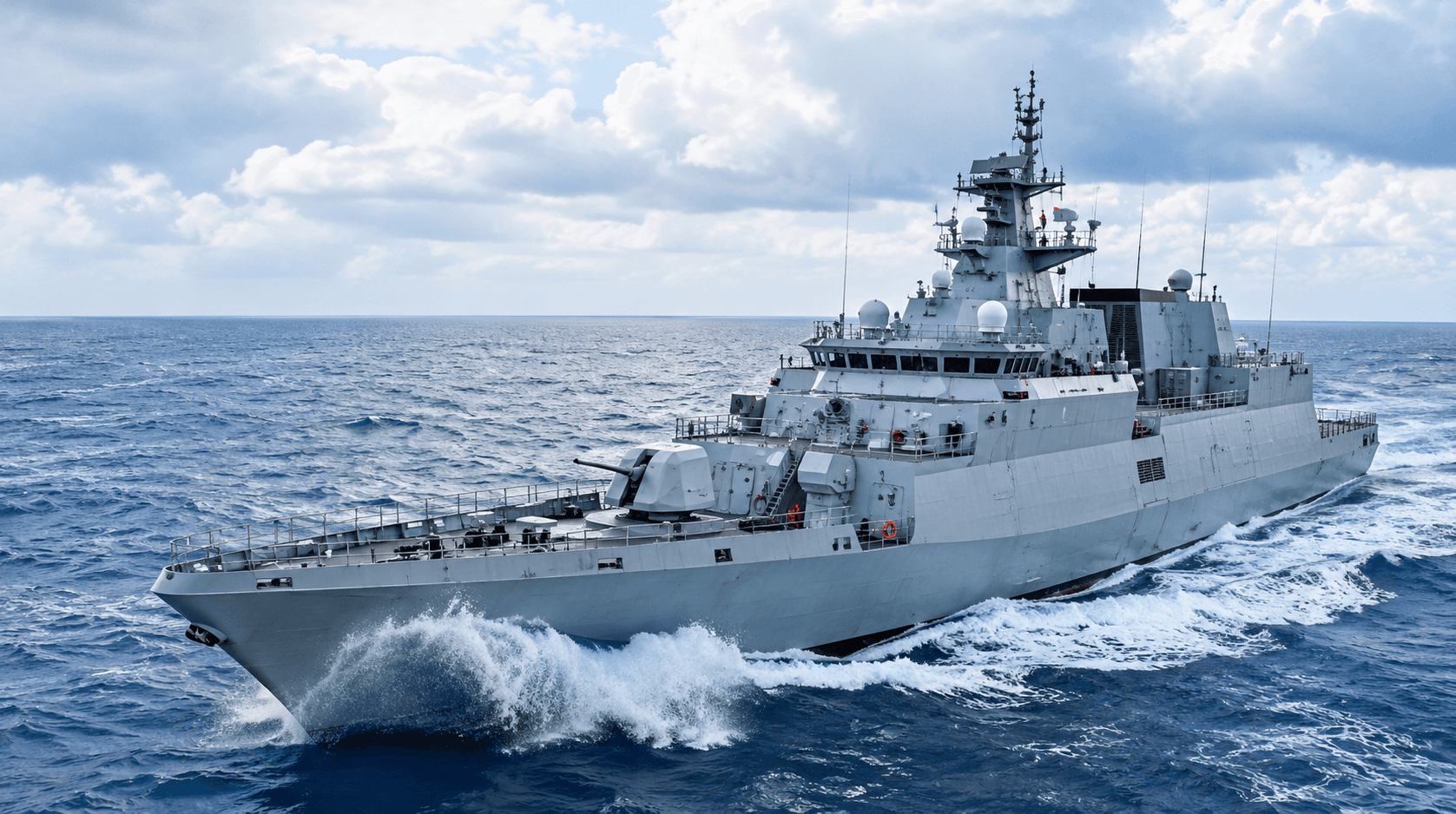
India has moved ahead with one of its major naval modernisation projects after signing contracts worth ₹53,866.50 crore for eight Next Generation Corvettes (NGCs) for the Indian Navy.
The Ministry of Defence signed the agreements with Garden Reach Shipbuilders and Engineers Limited (GRSE) and Goa Shipyard Limited (GSL) on 2 November 2026 in New Delhi. Defence Secretary Rajesh Kumar Singh was present at the signing ceremony.
Under the arrangement, GRSE will build five corvettes, while GSL will be responsible for the other three. The ships will follow designs developed by the Indian Navy and will be constructed by the two defence public sector shipyards selected through a competitive process.
Beyond adding new warships to the fleet, the programme reflects India's growing focus on developing advanced defence equipment at home and reducing dependence on overseas suppliers. It is also expected to generate business for domestic manufacturers, engineering companies and smaller industrial suppliers.
EIGHT NEW WARSHIPS TO STRENGTHEN NAVAL CAPABILITIES
The eight corvettes are being designed to handle a range of naval operations, giving the Indian Navy greater flexibility across different maritime environments.
The vessels are expected to feature advanced weapons, missiles and sensor systems, enabling them to operate against threats in the air, on the surface and beneath the sea.
Their planned roles include anti-surface warfare, anti-submarine operations, coastal defence, littoral combat and maritime surveillance. They will also support efforts to protect important shipping routes and strengthen India's presence in strategically significant waters.
With modern combat and surveillance systems, the new vessels are expected to improve the Navy's ability to respond to changing security challenges. They will also add to the capabilities of India's existing corvette fleet.
GRSE AND GOA SHIPYARD LEAD THE CONSTRUCTION PROGRAMME
The project brings two established Indian shipbuilders into a central role in the Navy's expansion plans.
Kolkata-based GRSE will construct five of the eight vessels. The shipyard has considerable experience in naval construction, having delivered frigates, anti-submarine warfare craft and other vessels for the Indian Navy.
Goa Shipyard Limited will build the remaining three corvettes, adding to its contribution to India's domestic defence manufacturing capabilities.
The decision to divide construction between the two shipyards follows a competitive selection process. It is also expected to encourage greater coordination between public sector shipbuilders, private industry and domestic equipment manufacturers.
For India's shipbuilding sector, the programme represents an opportunity to expand production capacity and develop expertise in building increasingly sophisticated naval platforms.
MAKE IN INDIA GETS A MAJOR DEFENCE BOOST
The ₹53,866.50-crore agreement is another important step in India's push to build a stronger and more self-reliant defence industry.
With the vessels being designed by the Indian Navy and constructed at domestic shipyards, the programme is expected to create opportunities for Indian engineering firms, technology companies, equipment manufacturers and specialist suppliers.
The Ministry of Defence has highlighted the importance of using indigenous materials, locally developed technologies and Indian technical expertise throughout the project.
This approach could have benefits beyond the eight corvettes themselves. Building more advanced warships domestically will help strengthen India's industrial capabilities and improve its ability to design, manufacture and maintain complex naval equipment.
The programme also supports the wider Aatmanirbhar Bharat initiative, which aims to reduce India's reliance on foreign defence imports while expanding domestic production.
WARSHIP PROJECT EXPECTED TO GENERATE MILLIONS OF WORKING DAYS
The construction programme is expected to create substantial employment across shipyards and supporting industries over the next decade.
According to the Ministry of Defence, the project is likely to generate:
72 lakh person-days of employment at the shipyards.
460 lakh person-days of employment across ancillary industries and MSMEs.
These opportunities are expected to benefit workers and businesses involved in engineering, fabrication, electronics, equipment manufacturing, logistics and other supporting services.
Small and medium-sized businesses could also benefit from supplying components, specialised equipment and technical services required for the construction of the warships.
The projected employment impact highlights how major defence contracts can support a much wider industrial network, extending well beyond the shipyards directly involved in construction.
STRATEGIC IMPORTANCE FOR INDIA'S MARITIME SECURITY
Securing India's maritime interests has become an increasingly important national priority, particularly as the country's trade and energy supplies depend heavily on international shipping routes.
The Indian Ocean Region is home to several strategically important commercial and energy corridors. Maintaining surveillance, protecting coastal areas and ensuring the security of shipping lanes are therefore essential to India's economic and national security.
The new corvettes are expected to strengthen the Navy's ability to monitor maritime activity and respond to threats both above and below the water.
Their anti-submarine and anti-surface warfare capabilities will be particularly valuable as regional naval competition and maritime security challenges continue to evolve.
The vessels will also provide additional support for coastal operations, surveillance missions and the protection of strategically important waters.
INDIA'S NAVAL MODERNISATION GAINS MOMENTUM
The corvette deal forms part of India's broader effort to modernise its naval fleet and prepare for future maritime security challenges.
The Indian Navy has been pursuing several indigenous shipbuilding and procurement programmes to improve its operational capabilities across the Indian Ocean Region.
At the same time, the government is working to develop a domestic defence ecosystem that can support advanced military platforms throughout their service lives, from design and construction to maintenance and upgrades.
In this context, the ₹53,866.50-crore agreement represents more than the addition of eight warships to the Navy. It is also an investment in India's shipbuilding infrastructure, technical expertise and long-term defence manufacturing capacity.
The project's success will depend on close coordination between the Navy, shipyards, equipment manufacturers and the wider supplier network.
RISKS AND KEY ISSUES TO WATCH
Despite the scale of the programme, several factors will determine how successfully it is delivered.
Construction timelines: GRSE and Goa Shipyard will need to coordinate their work effectively to complete all eight vessels within the planned schedule.
Indigenous technology: The performance and reliability of domestically developed weapons, sensors and other onboard systems will be crucial.
Supply-chain readiness: Indian manufacturers and MSMEs must maintain the quality and production standards required for modern naval vessels.
Cost management: Controlling expenses throughout this large, multi-year defence programme will remain important.
Operational integration: The new corvettes must work effectively with the Navy's existing ships, weapons, sensors and command systems.
Changing security needs: The vessels must remain capable of addressing evolving maritime threats and advances in naval technology.
WHAT TO WATCH NEXT
Construction progress: Updates on the development of the eight vessels at GRSE and Goa Shipyard.
Design and engineering: Further details about the indigenous technologies, weapons and sensor systems planned for the corvettes.
Industry participation: The involvement of private manufacturers and MSMEs in supplying components and equipment.
Employment generation: Whether the programme delivers its projected 532 lakh person-days of employment over ten years.
First vessel launch: Progress towards the launch and eventual delivery of the first corvette.
Naval induction: The timeline for testing, delivery and entry into active Indian Navy service.
FACT CHECK METER
Editorial confidence: 99%
Strongly supported — Ministry of Defence confirmation
Confirmed details:
Total contract value: ₹53,866.50 crore.
Eight Next Generation Corvettes planned for the Indian Navy.
GRSE will construct five vessels, while Goa Shipyard will build three.
Contracts signed on 2 November 2026 in New Delhi.
Projected employment: 72 lakh person-days in shipyards and 460 lakh person-days in ancillary industries and MSMEs.
Important distinctions:
The agreements cover the construction of eight warships. They do not mean that the vessels have already been built or launched.
Delivery and induction into naval service will take place after construction, testing and other required procedures.
The employment figures are projections spread across ten years, not jobs already created.
AWX VERDICT
India's ₹53,866.50-crore corvette programme is a significant development for the country's naval modernisation and indigenous defence manufacturing ambitions.
The agreement gives two Indian shipyards a major role in building the Navy's next-generation warships while creating opportunities for domestic suppliers and supporting industries.
However, the real measure of success will be timely construction, dependable indigenous technology and the successful integration of all eight vessels into the Navy's operational fleet.
The programme has the potential to strengthen both India's maritime capabilities and its position as a growing domestic defence manufacturing hub.
THE AWX BOTTOM LINE
India's decision to invest ₹53,866.50 crore in eight new corvettes reflects its determination to strengthen maritime security while building more advanced defence equipment at home.
The programme is expected to expand the capabilities of the Indian Navy, support domestic shipyards and generate significant employment across the manufacturing sector.
It also reinforces a broader national priority: reducing dependence on foreign defence suppliers by investing in Indian technology, engineering and industrial expertise.
For now, the focus shifts to execution. The timely construction, successful testing and eventual induction of all eight warships will determine the programme's lasting contribution to India's naval strength.
ATTLAS NEWS | AWX WORLD NEWS
Real Stories. Lasting Impact.



Comments
No comments yet.