

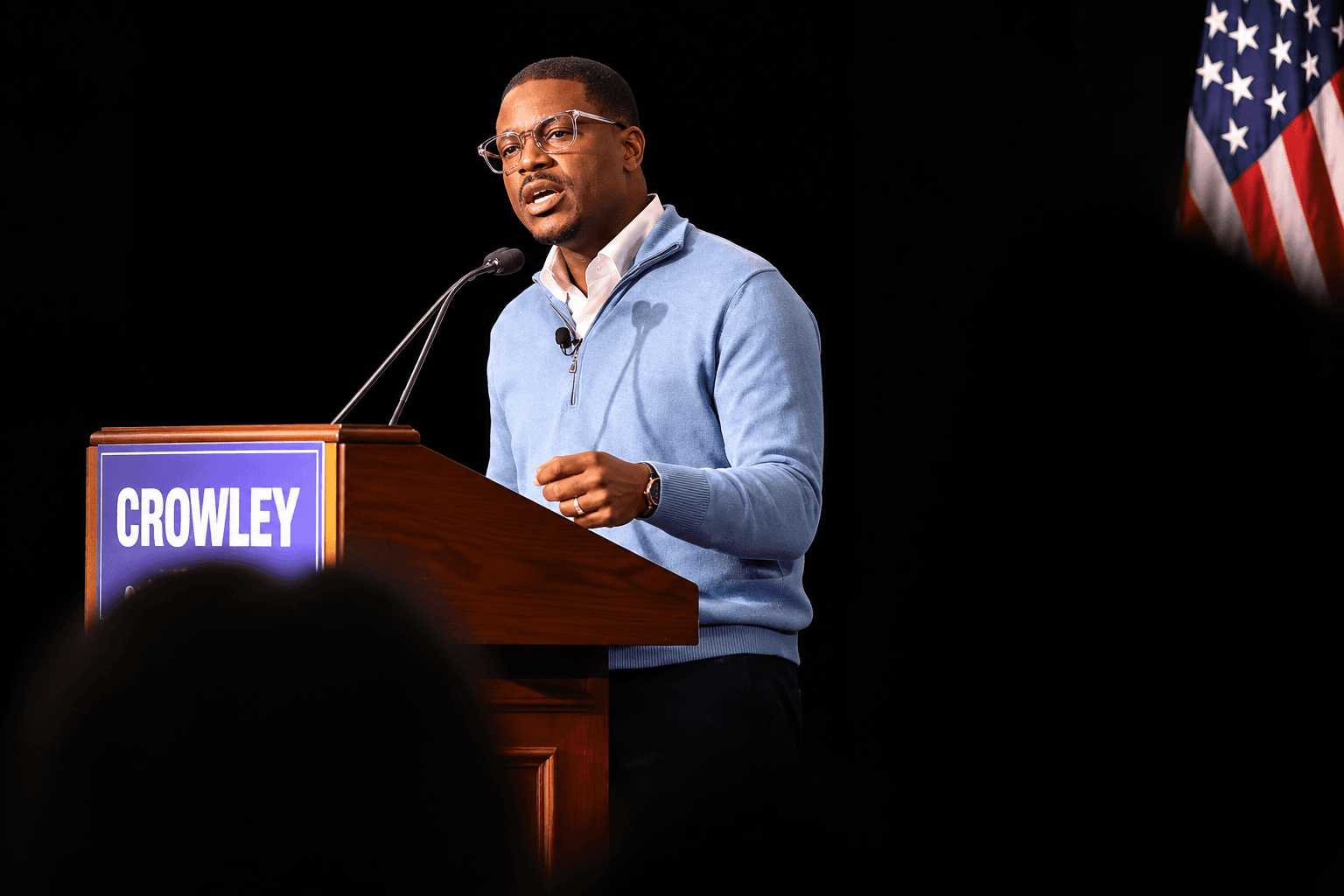
Wisconsin is preparing for a historic change in leadership after Democrat David Crowley defeated Republican US Representative Tom Tiffany in the November 3 gubernatorial election.
Crowley's victory makes him the first Black person elected governor in the state's 178-year history, marking a significant moment for political representation in the Midwest.
The 40-year-old Milwaukee County executive secured approximately 54.1% of the vote, according to preliminary results reported by the Associated Press. Tiffany conceded the race, paving the way for Crowley to succeed outgoing Democratic Governor Tony Evers, who chose not to seek another term.
The result is part of a broader Democratic comeback across the country. It also gives the party control of Wisconsin's governorship and both chambers of the state legislature, creating an opportunity to reshape the state's political direction after years of Republican influence in Madison.
CROWLEY MAKES HISTORY WITH LANDMARK ELECTION VICTORY
Crowley's election represents a milestone in Wisconsin's political history. When he takes office in January 2027, he will become the state's first Black governor.
Addressing supporters in Milwaukee after his victory, Crowley promised to represent everyone in Wisconsin, regardless of how they voted. He called for a government that brings communities together rather than dividing residents along party lines.
His victory speech focused heavily on everyday concerns, including affordable housing, childcare, healthcare, rising utility bills and property taxes. He also pledged to improve public education and make state government more transparent and accountable.
The victory carries particular significance for Milwaukee, where Crowley built his political career and previously served as county executive. His journey from a challenging childhood in one of the city's poorest neighbourhoods to the governor's office has become an important part of his public story.
FROM MILWAUKEE'S NORTH SIDE TO THE GOVERNOR'S OFFICE
Crowley was born and raised on Milwaukee's north side, where his childhood was marked by financial hardship and family difficulties. He has spoken publicly about his parents' struggles with substance abuse and the housing insecurity that led to repeated evictions.
Those early experiences helped shape his interest in public service, community development and improving opportunities for struggling families.
His political career began in 2016, when he won a seat in the Wisconsin State Assembly. Four years later, he was elected Milwaukee County executive, becoming both the youngest and the first Black person to hold the position.
During his time in county government, Crowley focused on improving public services, supporting economic development and addressing inequalities affecting local communities. He secured re-election in 2024 before turning his attention to the governor's race.
His campaign for the Democratic nomination faced an unexpected setback when he briefly withdrew from the contest in July 2026. However, he later returned after Lieutenant Governor Sara Rodriguez ended her campaign.
With the backing of outgoing Governor Tony Evers, Crowley went on to defeat state Representative Francesca Hong in a closely fought Democratic primary. That victory set up his eventual showdown with Tiffany in the general election.
DEMOCRATS REGAIN CONTROL OF WISCONSIN'S STATE GOVERNMENT
Crowley's victory was accompanied by significant Democratic gains in the state legislature.
According to preliminary Associated Press results, Democrats secured an 18–15 majority in the Wisconsin Senate and a 53–46 majority in the State Assembly.
The outcome ends Republican control of the state legislature, which had continued since 2011. Democrats have not enjoyed unified control of Wisconsin's state government since 2010.
The political shift follows changes to Wisconsin's legislative boundaries after the state Supreme Court struck down the previous maps in 2023. A new map agreement between Governor Tony Evers and the Republican-led legislature subsequently reshaped the electoral landscape.
With Democrats now controlling the governor's office and both legislative chambers, Crowley will have a stronger position from which to pursue his campaign commitments.
However, winning political control is only the first step. Turning those promises into legislation will require cooperation among lawmakers, careful budgeting and decisions about which reforms should take priority.
COST OF LIVING EMERGES AS A MAJOR ELECTION ISSUE
The rising cost of everyday necessities was one of the biggest concerns for Wisconsin voters during the campaign.
A Marquette University Law School poll conducted ahead of the election found that 48% of registered voters identified inflation and the cost of living as their most important issue. Another 17% ranked it as their second-biggest concern.
Crowley made household affordability a central part of his campaign, promising to ease financial pressure through more affordable housing, property-tax relief, lower childcare expenses and improved access to healthcare.
He also highlighted the need to make electricity and utility bills more manageable while supporting stronger investment in public schools.
The message resonated with voters facing growing financial pressures and looking for practical solutions rather than political promises alone.
For the incoming administration, delivering meaningful progress on these issues will be one of its most important tests.
TRUMP'S ENDORSEMENT FAILS TO SECURE VICTORY FOR REPUBLICAN CANDIDATE
Republican candidate Tom Tiffany entered the race with the backing of President Donald Trump and considerable support from conservative donors.
Tiffany presented himself as a candidate capable of working across party lines while maintaining his conservative positions. His campaign also questioned Crowley's record in Milwaukee County, raising concerns about crime, taxation and public spending.
Crowley took a different approach, repeatedly linking Tiffany to Trump's broader political agenda and portraying the election as a choice between competing visions for Wisconsin.
The Republican campaign also faced an increasingly difficult national political environment as Democrats gained momentum in the 2026 midterms.
A Marquette University Law School poll released shortly before the election put Trump's approval rating in Wisconsin at 37% among registered voters, adding to concerns about the political climate facing Republican candidates.
Despite Trump's endorsement and substantial financial backing, Tiffany was unable to overcome the Democratic momentum or secure enough votes to win the governorship.
CROWLEY'S AGENDA CENTRES ON HEALTHCARE, EDUCATION AND HOUSING
As governor-elect, Crowley now faces the challenge of turning his campaign commitments into policies that make a measurable difference.
His priorities include expanding access to affordable healthcare, strengthening public education and addressing housing insecurity. He has also expressed support for expanding Medicaid and reversing Act 10, the 2011 Wisconsin law that significantly restricted collective bargaining rights for most public-sector employees.
Other areas of focus include stronger protections for renters, reproductive rights and measures aimed at improving economic conditions for working families.
The new Democratic majorities in both legislative chambers could make it easier for Crowley to advance his proposals than under the previous Republican-controlled legislature.
Even so, major reforms will require detailed planning, sustainable funding and agreement among lawmakers. The incoming administration will need to balance its ambitions with the financial and practical challenges of governing the state.
WISCONSIN'S RESULT COULD SHAPE THE ROAD TO 2028
Wisconsin remains one of the most closely watched battleground states in American politics. Its electoral votes and competitive electorate make it an important destination for both parties during presidential campaigns.
Crowley's victory gives Democrats a stronger political position heading into the 2028 presidential election cycle. Control of the governor's office and both legislative chambers could also help the party strengthen its organisation and advance its policy priorities.
For Republicans, the defeat raises questions about their campaign strategy, the effectiveness of Trump's influence and their ability to retain support in competitive states.
However, the result does not guarantee a Democratic victory in Wisconsin in 2028. Presidential elections involve different candidates, national issues and voter priorities.
What is clear is that Democrats have gained a significant advantage in the state, while Republicans face the task of rebuilding their position ahead of the next national election.
RISKS AND KEY ISSUES TO WATCH
Legislative implementation: Crowley will face pressure to turn his campaign commitments into legislation and deliver visible results.
Cost-of-living pressures: Housing, healthcare, childcare and utility bills will remain major challenges for the incoming administration.
Republican opposition: Proposed changes to education, taxation and labour policies could face resistance from Republican lawmakers and interest groups.
Public-sector labour reforms: Any attempt to reverse Act 10 could trigger significant political and legal debate.
State budget pressures: Expanding healthcare and public services will require sustainable funding and careful financial planning.
Public expectations: Crowley's historic victory has raised expectations among Democratic voters and communities seeking greater political representation.
WHAT TO WATCH NEXT
The formation of Crowley's transition team and the appointment of senior administration officials.
His first legislative priorities when the new administration takes office in January 2027.
Proposed changes involving healthcare, Medicaid and public education.
Plans to address affordable housing, property taxes and childcare expenses.
Whether the new Democratic legislative majority moves to reverse Act 10.
How Republicans respond to losing control of Wisconsin's state government.
Wisconsin's political direction as the 2028 US presidential election approaches.
FACT CHECK METER
Editorial confidence: 98%
Strongly supported — Associated Press, Wisconsin Public Radio and state election reporting.
Confirmed details
David Crowley defeated Republican Tom Tiffany in the November 3, 2026 gubernatorial election.
Crowley will become the first Black governor in Wisconsin's history.
He received approximately 54.1% of the vote in preliminary Associated Press results.
Democrats secured majorities in both chambers of the Wisconsin legislature.
Crowley is expected to succeed Governor Tony Evers in January 2027.
Important distinctions
The election figures cited in this report are preliminary and remain subject to official certification.
Democratic control of the legislature does not mean every campaign proposal will automatically become law.
The Democratic victory in Wisconsin does not guarantee the state's political direction in 2028.
AWX VERDICT
The election result and its historic significance are supported by Associated Press reporting and Wisconsin election coverage. Crowley's victory represents a major change in the state's political leadership, while the Democratic gains in the legislature give the incoming administration greater room to pursue its agenda.
The longer-term economic and political impact, however, will depend on how effectively Crowley governs and whether the new legislative majority can translate its promises into practical reforms.
The 98% figure represents AWX's editorial confidence in the factual reporting presented here. It is not a statistical probability or an official rating.
THE AWX BOTTOM LINE
David Crowley's victory marks a historic turning point for Wisconsin. By defeating Republican Tom Tiffany, he has made history as the state's first Black governor while helping Democrats regain control of the entire state government.
His journey from Milwaukee's north side to the governor's office is a significant personal and political achievement. But the election was about more than representation. It also reflected growing voter concerns over affordability, healthcare, education and the direction of American politics.
With Democrats controlling both legislative chambers, Crowley will have an opportunity to pursue an ambitious programme of reforms. The real challenge begins now: turning campaign commitments into meaningful improvements in people's everyday lives.
Wisconsin's result is more than a historic election victory. It signals a major political shift in one of America's most closely contested battleground states and could have implications well beyond its borders as the country looks towards 2028.
ATTLAS NEWS | AWX WORLD NEWS
Real Stories. Lasting Impact.

Comments
No comments yet.